
international voip calls
A Simple Guide to International VoIP Calls
Tired of those eye-watering international phone bills? There’s a much smarter way to stay connected with family, friends, and clients across the globe. It's called International VoIP, and it uses the internet to slash your calling costs and give you way more flexibility than your old landline.
Think of a traditional phone call like sending a package via a private courier service. Your voice travels on a dedicated, physical route of copper wires and switching stations—the Public Switched Telephone Network (PSTN). Every mile costs money, and you're the one footing the bill for that expensive, old-school infrastructure. For decades, this was the only game in town, which is why a simple call overseas could cost a small fortune.
Voice over Internet Protocol (VoIP) completely changes the game. Instead of booking that private courier, VoIP is like sending your package through the global postal system—the internet. It cleverly converts your voice into tiny digital packets and sends them over the same networks you already use for email and Netflix. This simple shift from analog lines to digital data is what makes international VoIP calls so revolutionary. It bypasses the old, expensive toll roads entirely.
This isn't just a minor tech upgrade; it's a fundamental change that makes global communication affordable for everyone. Whether you're calling your parents back home, coordinating with a freelancer in another time zone, or supporting international customers, VoIP makes it practical and cheap.
This is about more than just saving a few bucks. It's about breaking down the financial walls that used to make global communication a luxury. VoIP gives everyone the power to connect, no matter where they are.
Once you grasp the difference between the old private couriers and the new internet superhighway, everything clicks. You start to see how this technology makes the world feel a little smaller and those painful phone bills a distant memory.
Ever wondered what’s really going on behind the scenes when you make a call over the internet? It sounds complex, but the process is surprisingly clever and simple once you break it down.
Think of a traditional phone call like booking a private, exclusive road just for your conversation. It’s a direct physical connection, which is why it's so expensive. If that road gets blocked or congested, your call quality drops. It’s an old, inefficient system.
International VoIP calls are completely different. Imagine you need to send a long letter overseas. Instead of mailing one giant sheet of paper that could easily get lost, you tear it into hundreds of tiny, numbered postcards. You then drop all those postcards into the global mail system—the internet. Each one zips along the fastest, cheapest route available at that very second.
This "postcard" method is exactly how VoIP handles your voice.
The moment you speak into your microphone or headset, your VoIP software instantly captures your voice. It takes that analog sound wave and converts it into digital information. This is called digitization.
But sending one long, continuous stream of audio across the internet would be slow and clunky. So, the system does something brilliant: it chops that digital information into small, manageable chunks called data packets. Each packet is just like one of our numbered postcards. It contains a tiny piece of your voice, plus critical info like where it's going and its exact place in the sequence.
These packets are then sent out over the internet, and this is where the real magic happens. They don’t all travel together. Some might zip through servers in Frankfurt, while others take a detour through Singapore. The internet’s infrastructure automatically finds the most efficient path for every single packet, in real-time.
Once all the packets arrive at their destination—your recipient’s device—the process happens in reverse. The VoIP software on their end acts like a mail clerk, collecting all the incoming "postcards." Using the sequence numbers, it reassembles them in the correct order, instantly and seamlessly.
This rebuilt stream of data is then converted back into analog sound waves, which play through the recipient’s speakers. The entire journey—from your voice to thousands of packets, across the globe, and back to a voice again—happens in milliseconds. That's what makes a clear, real-time conversation possible, even with someone on the other side of the planet.
This infographic shows just how far we've come from the clunky, expensive 'old way' to the smart, efficient 'new way' of making global calls.
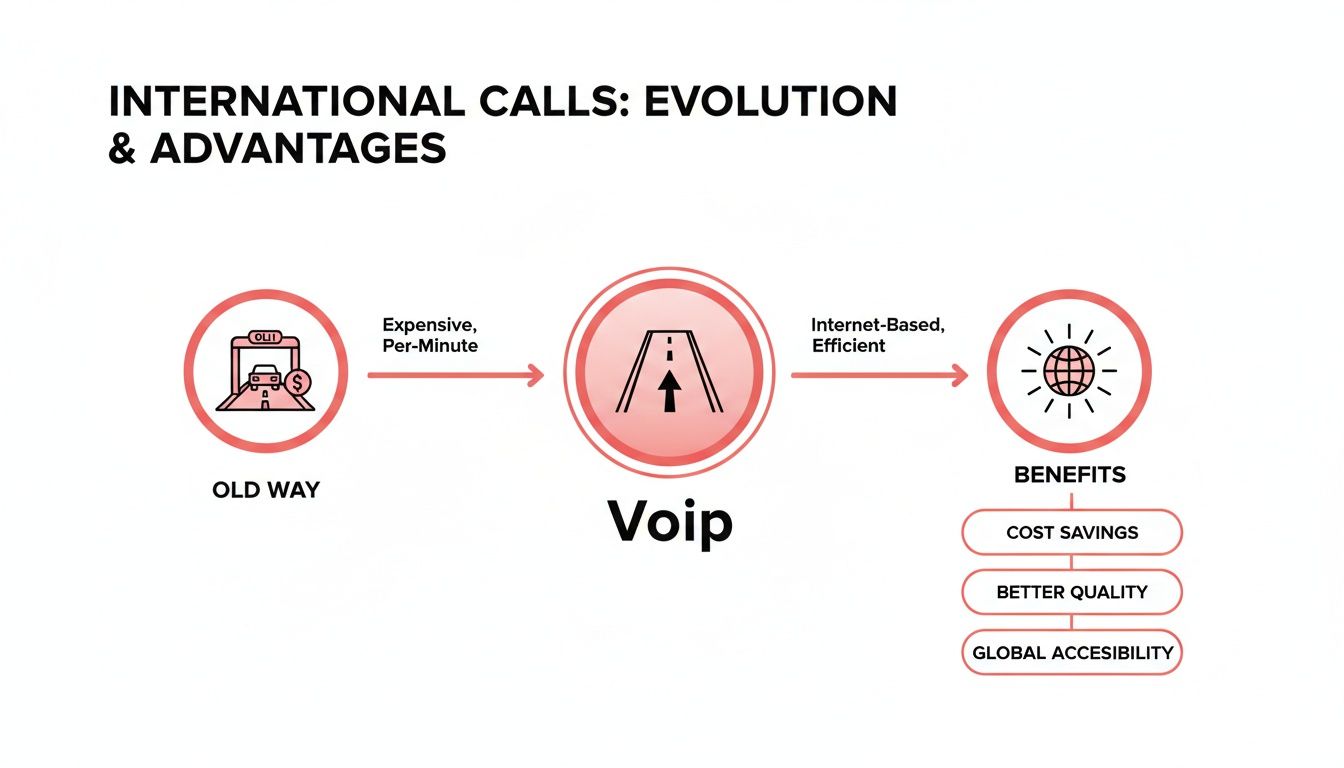
It’s easy to see why this technology took off. By bypassing the old, costly phone networks and using the internet as a global highway, VoIP unlocked massive savings and flexibility.
This shift has been huge. The global VoIP market rocketed to around USD 161.79 billion last year and is on track to hit USD 250 billion by 2033. Why? Because businesses and regular people are saving a ton of money—often up to 40%—by ditching their old phone lines. You can see the full market breakdown from the folks at Precedence Research.
At the end of the day, understanding how international VoIP calls work shows you why the technology is so powerful. It treats your voice like any other data, sending it over the vast, cost-effective internet. It’s a system truly built for the modern, connected world. If you want to dive deeper, check out our complete guide to VoIP international calling.
Moving your international calls to VoIP isn't just a small tech upgrade. It’s a completely different way of connecting with the world, and the advantages are huge. We're talking about more than just shaving a few cents off your bill; this shift impacts how you work, travel, and stay in touch with people across the globe.
It all boils down to three game-changing benefits: massive cost savings, incredible flexibility, and a toolkit of powerful features that old-school phone lines just can't deliver. Let's dig into each one.
Let's be honest, the number one reason people switch to VoIP is the money they save. And the savings are dramatic. Traditional phone companies are stuck with expensive, decades-old infrastructure and complicated deals between carriers. Guess who pays for all that? You do, in the form of sky-high per-minute rates.
VoIP throws that entire system out the window. By sending your calls over the internet, it bypasses those costly toll roads completely. This means the provider’s costs are way lower, and they pass those savings directly to you. For a freelancer with clients in Europe or a family calling relatives in Asia, this can easily add up to hundreds of dollars saved every year.
Providers like YodelPhone use a simple, pay-as-you-go model, so you only pay for the minutes you actually use. It’s a breath of fresh air compared to traditional plans that lock you into expensive monthly subscriptions or bundles you never needed in the first place.
The VoIP revolution has reshaped international calling since the early 2000s, turning it into a powerhouse industry. This shift has overtaken traditional networks, with VoIP now the default for 36% of voice services globally, fueled by broadband expansion and remote work. A key milestone is the dominance of cloud deployments, which can reduce communication expenses by 40% and enable instant connections to over 180 countries without contracts. Discover more insights about the VoIP industry's growth at Speedflow.
Think about your old landline—it’s physically stuck to a wall in your house or office. Even your mobile plan is tied to a specific SIM card in a specific phone. VoIP cuts those cords and gives you true freedom.
Because your phone number is tied to your account—not a device—you can make and receive international VoIP calls from anywhere with an internet connection. All you need is a modern web browser.
This kind of flexibility is a must-have for today’s remote teams and global citizens. It puts you in control, letting you stay connected on your terms, wherever you happen to be.
Beyond the savings and freedom, VoIP brings a whole suite of digital tools that old-fashioned phone systems can't even dream of. These features give you more control, better insights, and a much more professional way to communicate.
For instance, your old phone bill just gives you a list of numbers you called. A modern VoIP platform like YodelPhone provides a detailed call history with analytics, showing you call durations, costs per call, and trends over time. This is perfect for helping individuals and small teams manage their budgets with real data.
Another killer feature is the ability to get virtual international numbers. A small business in the U.S. can buy a local UK phone number. When clients in London dial that number, the call gets routed seamlessly over the internet to the business in the States. This creates a professional, local presence without needing a physical office, making international customers feel much more comfortable calling you.
Deciding to switch to VoIP is the easy part. The real work starts when you have to pick a provider from a market flooded with options.
Not all VoIP services are the same. Some are built for giant corporations with massive call centers, while others are designed for individuals and small teams who just need simple, affordable calling. Choosing the right one means looking past the flashy ads and understanding how you actually make calls.
Before you even start comparing providers, take a minute to think about your own habits. A quick self-assessment will give you a checklist that makes picking the right service a breeze.
Ask yourself these questions:
Getting these answers down first stops you from being swayed by fancy features you'll never use or signing up for a plan that's a terrible fit for your calling patterns.
VoIP pricing really boils down to two main types: monthly subscriptions and pay-as-you-go. Getting this one right will save you a ton of money.
Subscription Plans are what you'll see from the big players. They offer a bundle of minutes or "unlimited" calling to certain countries for a flat monthly fee. This can be great if you make a lot of predictable calls to the same few places. But be careful with the word "unlimited"—it usually only covers a handful of popular countries like the US and Canada. Calling anywhere else can hit you with surprisingly high per-minute charges.
Pay-As-You-Go Models, like the one we use at YodelPhone, offer total flexibility. You just add credit to your account and only pay for the minutes you actually talk. It’s the perfect model for:
With pay-as-you-go, you're never paying for minutes you didn't use. It’s the most honest and, for most people, the most cost-effective way to handle international calls.
Whatever you do, always hunt for hidden costs. Some services sneak in connection fees, maintenance fees, or demand a minimum monthly spend. A good provider puts all their pricing upfront, with no nasty surprises on your bill.
Price isn't everything. A cheap service is useless if the connection is choppy or your calls aren't private. This is especially true if you're using it for business.
Look for providers that talk about HD (High-Definition) voice quality. This is your guarantee that calls will be crisp and clear, without the annoying echoes and delays that gave early VoIP a bad name. Check for reliability, too—does the provider have a public status page or offer an uptime guarantee?
Security is another dealbreaker. Your voice calls are data, and that data needs to be protected. Make sure the service you choose uses end-to-end encryption. This technology scrambles your conversation, making it completely unreadable to anyone trying to listen in. It’s essential for protecting your privacy and any sensitive information you share.
If you want to see how different services stack up, our guide on the best international calling apps breaks down the top options to help you narrow your search. Finding that sweet spot between price, quality, and security is the key to making your switch to VoIP a total success.
Jumping into the world of international VoIP calls is way easier than it sounds. Forget about clunky software or complicated setups. Modern services are built to get you connected in just a couple of clicks, making the whole thing feel as simple as sending an email.

Honestly, the best way to see how it works is just to do it. Let's walk through it using a browser-based platform like YodelPhone. You'll see just how fast you can go from signing up to chatting with someone on the other side of the planet.
First things first. Most VoIP providers worth their salt want you to hear the call quality before you even think about paying. That’s why they offer free trials. Look for one that doesn't demand a credit card upfront, so you can test it out with zero risk.
You'll usually just pop in your email and create a password. The moment you're done, you’re dropped right into the calling interface or "dialpad" in your web browser. No downloads, no installation. You can be ready to go in under a minute.
This is the one part where you need to be a little precise, but it's not complicated. Getting your call to connect just requires a simple, three-part formula.
So, to call a London number like (020) 1234 5678 from the U.S., you'd actually dial: +44 20 1234 5678. Nailing this format is the key. If you need a hand with specific codes, our guide on how to call international numbers has everything you need.
With the number punched in correctly, there’s only one thing left to do: hit the "call" button. The very first time you do this, your browser will probably ask for permission to use your microphone—just click "Allow."
Within seconds, you should hear it ringing on the other end. That’s it! You've just made your first international VoIP call.
While the process itself is simple, a few good habits can make the difference between a choppy call and a crystal-clear one. Think of it like making sure you have good cell reception before you call someone.
While today's VoIP technology is incredibly reliable, international VoIP calls travel over the public internet. Think of it like a highway—sometimes, you hit a bit of traffic. When you run into issues like choppy audio or a dropped call, it's almost never a problem with the service itself. Most of the time, it’s just a minor hiccup with your local internet connection that you can fix in a few minutes.
Knowing what causes these little glitches puts you in control, so you can solve them without ever needing to contact support. Let’s walk through the most common issues and their surprisingly simple fixes. This will help you keep your conversations crystal-clear and reliable, every single time you dial.
Ever heard that annoying, robotic-sounding voice on a call? Or noticed a frustrating delay between when you speak and when the other person hears you? That's almost always a sign of an unstable internet connection.
Imagine your voice data is a steady stream of cars on a highway. If there's a traffic jam (internet congestion), some of those cars get delayed or lost, creating gaps in the conversation. This is usually caused by other devices or apps on your network hogging all the bandwidth. The good news? Clearing up this digital traffic jam is easy.
Here are a few quick things to try:
There’s nothing more frustrating than a call dropping right in the middle of an important conversation. This usually happens for one of two reasons: either your internet connection cut out completely for a moment, or your network's firewall is getting in the way.
A firewall acts like a security guard for your internet connection. Sometimes, it can be a little overzealous and accidentally block the data packets that are keeping your call alive.
The most common reason for a dropped call is a momentary loss of internet. Even a blip lasting just a few seconds is enough to end the connection. A quick router reboot is often all it takes to fix these underlying network glitches.
If you’re experiencing dropped calls, run through this simple checklist:
Jumping into something new always comes with a few questions. It's totally normal. We’ve rounded up the most common ones we hear about making international VoIP calls to give you some quick, straight-to-the-point answers.
Think of this as your final check-in before you start connecting with the world, minus the confusing tech talk.
Yes. Almost every single time. It's not just a little cheaper, either—it's a night-and-day difference.
Mobile carriers are infamous for their sky-high per-minute rates once you call outside the country. Their "international plans" often just tack on another monthly fee for the privilege of still paying inflated rates. And let's not even talk about roaming charges.
VoIP skips all that nonsense by sending your call over the internet. A pay-as-you-go service like YodelPhone, for instance, has rates that are often up to 90% cheaper than what the big mobile companies charge for the exact same call. You're not paying for their massive infrastructure or marketing budget; you're just paying for the tiny bit of data your voice uses.
It's like this: your mobile carrier sells you a pricey, all-inclusive travel package, even when all you needed was a simple bus ticket. VoIP just gives you the bus ticket—direct, cheap, and gets you exactly where you need to go.
Nope, not at all. This is probably the biggest myth about modern VoIP. A decade ago, you might have needed a clunky adapter or a special "IP phone" that looked like an office relic, but those days are long gone.
Today, you already have everything you need. Seriously.
For the absolute best audio, a simple headset with a mic is a great idea, but it’s definitely not a must-have to get started. You can literally make your first call right from your browser in seconds.
They are, as long as you pick a provider that actually cares about security. It’s a fair question—your voice is traveling across the internet, after all. But any reputable VoIP service uses the same type of tough security that protects your online banking and Amazon orders.
The key feature to look for is end-to-end encryption. This scrambles your conversation into unreadable code the second it leaves your device and only unscrambles it when it reaches the person you're calling. It makes it practically impossible for anyone to listen in, so your personal and business chats stay completely private.
Ready to see how easy it is? With YodelPhone, you can place your first high-quality, secure international call in less than a minute. No downloads, no contracts, just clear connections. Try YodelPhone for free and start calling today.

Uncover what is VoIP and how does it work with this clear, step-by-step guide. Learn the basics, benefits, and how to start making calls over the internet.

Discover voip international calling that delivers clear, affordable global calls from your browser. Learn pricing, setup, and start saving today.
Unlock affordable global calling with a pay as you go international phone service. Learn how to save on calls without contracts or hidden fees.

Discover how the international phone number for business can unlock global growth. Learn its benefits and how to choose the right provider.