
best calling card for international calls
Best calling card for international calls: Compare top options for savings

If you're picturing a flimsy plastic card with a scratch-off PIN, you're not alone—but that image is about a decade out of date. The whole idea of a "calling card" has been completely reinvented.
The best calling card for international calls today isn't a physical card at all. It's a digital service, like a VoIP app or a browser-based tool, that delivers far better rates, clearer quality, and more useful features without the old-school hassle and hidden fees.
For years, physical calling cards were the go-to option, found at every airport kiosk and convenience store. But their clunky process—dialing long access numbers, punching in PINs, and hoping the call connected—has made them practically obsolete.
Today's best solutions are services, not objects. This change is powered by Voice over Internet Protocol (VoIP), which sends calls over the internet instead of traditional phone lines. The result? Sharper connections, rock-bottom costs, and a bunch of smart features that physical cards could never dream of.
The market tells the same story. The international calling app space was recently valued at a massive USD 8.04 billion and is expected to hit USD 12.8 billion by 2035. This isn't a small trend; it's a complete shift in how people connect across borders.

Modern VoIP tools offer an experience that's light-years ahead of the old plastic cards. Being able to manage everything from a browser or a simple app is now the standard. For a deeper dive, check out our guide on the best international calling apps.
To see just how much things have changed, let's put the old and new methods side-by-side.
This table breaks down the core differences. It's not just about convenience; it's about transparency, quality, and control over your money.
| Feature | Traditional Calling Cards | Modern VoIP Services (e.g., YodelPhone) |
|---|---|---|
| Accessibility | Requires buying a physical card and manually dialing long access numbers and PINs. | Instant access from a web browser or app. One-click dialing. |
| Cost Structure | Riddled with hidden fees, minute rounding, and surprise connection charges. | Transparent pay-as-you-go or subscription pricing with crystal-clear rates. |
| Call Quality | Often unreliable, with static, delays, and a high chance of dropped calls. | Delivers HD voice quality for clear, stable, and professional-sounding calls. |
| Top-Up Method | Inconvenient. You have to buy a new card or find a specific retailer to add funds. | Simple online top-ups, auto-recharge options, and real-time balance tracking. |
| Advanced Features | Basic calling functionality only. Nothing more. | Includes call history, analytics, team accounts, caller ID, and more. |
What does this all mean for you? You’re no longer just buying a block of prepaid minutes that expire. You’re choosing a complete communication tool that fits right into your life or workflow. The focus has shifted from just making a call to making it efficiently, affordably, and with total control.
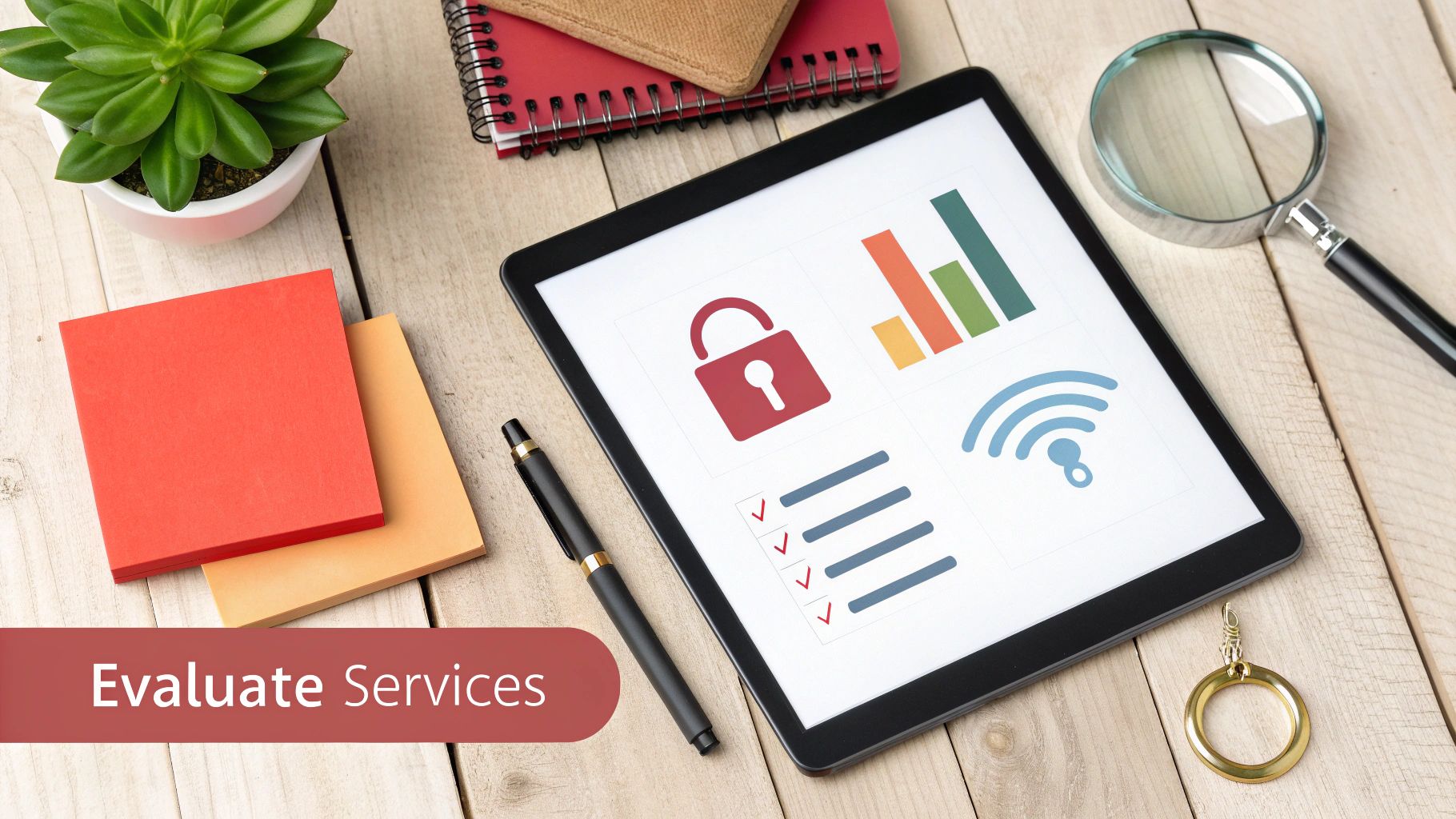
Finding the right international calling service isn't just about chasing the lowest per-minute rate. A cheap rate can quickly turn expensive if it's hiding a bunch of fees or the call quality is terrible. A truly great service offers real value, from see-through pricing to crystal-clear conversations.
To pick the right one, you need a game plan. Let’s walk through the essential things to look for when you're comparing modern calling services, so you can find one that actually fits what you need.
The oldest trick in the calling card book was the maze of hidden fees. You’d see a low rate advertised, only to get hit with connection fees, “maintenance” charges, and minute rounding—where your 61-second call gets billed as a full two minutes.
Today, there’s no excuse for that. A good service should be completely transparent. Look for a clear cost breakdown and walk away from any provider that’s cagey about how they bill.
Honestly, a service with a slightly higher per-minute rate but zero hidden fees will almost always save you money in the long run compared to one with a too-good-to-be-true rate and a laundry list of extra charges.
What’s the point of a cheap call if you can’t understand the person on the other end? Call quality is a dealbreaker, especially for business. Bad audio makes you sound unprofessional and just leads to frustration for everyone.
A service's reliability is more than just clear audio. It's about uptime, a stable connection, and the tech they use to fight common problems like jitter (choppy sound) and latency (that awkward delay).
Here are a few quality markers to watch for:
The best calling services today are simple. The days of punching in long access numbers and PIN codes are long gone. An easy-to-use interface, whether on a website or in an app, is the new standard.
Just as important is how you add money to your account. It should be fast and simple, so you can get back to your call without any headaches.
Think about these convenience factors:
Your calling service should work wherever you do. Whether you're on your desktop, laptop, or phone, making a call needs to be a smooth, consistent experience. The best services offer browser-based access and dedicated mobile apps. For a deeper dive into your options, check out our guide on how to make international calls.
Finally, don't skimp on security. Your calls, whether they're for business or catching up with family, are private. Make sure the provider uses strong security to protect your conversations. End-to-end encryption is the gold standard here—it means only you and the person you're calling can listen in. By looking at all these factors, you can move past the flashy ads and find a service that actually delivers.
When you need to make international calls, you’ll likely run into two main options: digital calling cards and browser-based VoIP services. They both let you call abroad without relying on your mobile carrier, but they work in fundamentally different ways. Understanding the split between them is the key to picking the right tool for the job.
A digital calling card is just the modern version of those plastic cards you used to buy at the corner store—you prepay for a block of minutes to call specific countries. On the other hand, a browser VoIP service is a full-blown communication platform. It lives in your web browser, letting you make calls without fumbling with access numbers or separate apps.
The choice isn't just about finding the cheapest rate; it's about how you need to communicate.
The first thing you'll notice is how they charge you. Digital calling cards are strictly pay-as-you-go. You buy a chunk of credit, and it drains with every call. This is fine for a one-off call or if you rarely phone internationally and want to keep a hard cap on spending.
Browser VoIP services like YodelPhone give you more options. While pay-as-you-go is available, many platforms are built around flexible plans that can include a dedicated business number, a suite of professional features, and sometimes even unlimited calling packages. This structure gives you predictable costs, which is a lifesaver for any business trying to manage a budget.
Think of it this way: a digital calling card is a disposable product you buy minutes. A browser VoIP service is an ongoing tool you subscribe to for communication.
This distinction changes everything. With prepaid cards, you’re always watching your balance, worried it’ll run out mid-conversation. With a service like YodelPhone, you get a permanent business line and a whole toolbox of features that do much more than just place a call. The market is clearly heading in this direction—projections show it growing from USD 1.44 billion to USD 2.29 billion by 2032, fueled by demand for cloud-based tools that offer more than just a dial tone. You can see the full trend analysis on the international call services market.
Before we dive deeper, let's lay out the core differences side-by-side. It becomes pretty clear where each one shines.
| Evaluation Criteria | Digital Calling Card Services | Browser-Based VoIP (e.g., YodelPhone) |
|---|---|---|
| Primary Use Case | Infrequent personal calls, budget-conscious one-offs. | Business communications, remote teams, frequent international callers. |
| Cost Model | Strictly pay-as-you-go. Buy credit, use minutes. | Flexible subscriptions, pay-as-you-go, or bundled plans. |
| Advanced Features | None. Basic dialing and balance check only. | Yes. Call recording, IVR, call forwarding, business hours, analytics. |
| Team Collaboration | Not supported. Designed for individual use. | Yes. Shared numbers, team inboxes, call history, internal notes. |
| Tool Integrations | No. Standalone service. | Yes. Integrates with CRM, Slack, helpdesks (HubSpot, Salesforce). |
| User Experience | Clunky. Requires opening a separate app or dialing access numbers. | Seamless. Click-to-call directly from browser or CRM. No downloads. |
| Device Compatibility | App-dependent, usually requires a smartphone. | Works on any device with a web browser (desktop, laptop, tablet). |
| Business Identity | Uses a random or shared number; no professional identity. | Provides a dedicated business number and verified Caller ID. |
As the table shows, one is a simple utility, and the other is a comprehensive business tool.
Here’s where the two options really diverge. Digital calling cards are built to do one thing: make a call. That's it. The feature list starts and ends with dialing a number and checking how many minutes you have left.
Browser-based VoIP platforms are in a different league entirely. They aren't just for calling; they're for managing all your business communications.
These features turn a simple phone line into a genuine business asset that helps you work smarter.
The day-to-day experience is another massive differentiator. Using a digital calling card feels like a chore. You have to stop what you're doing, open a separate app, maybe look up an access number, and then dial. It’s a completely separate process.
Browser VoIP, on the other hand, is all about seamless workflow. Because it runs in your browser, you can make a call just by clicking a phone number on a website or inside your CRM. No downloads, no switching between apps—just instant communication.
This YodelPhone interface shows exactly what that looks like in practice. Everything is right there in your digital workspace.
The dialpad, call history, and contacts are all in one place. You never have to break your focus.
For businesses, this integration is a game-changer. A salesperson can call a lead directly from their profile in the CRM, and the call logs automatically. A support agent can take a call without ever leaving their helpdesk software. It saves an incredible amount of time and eliminates the tedious task of manual data entry. A calling card just can't compete with that.
Figuring out the best way to make international calls really boils down to your specific needs. What works for a global business is complete overkill for someone just calling home once in a while. To find the right fit, you have to look past the flashy advertised rates and get honest about your own calling habits.
We're going to break this down into a few common scenarios. Think of them as user "personas." By seeing which one sounds most like you, you can zero in on the features and pricing that actually make sense, saving you from paying for bells and whistles you'll never touch.
Picture this: you're constantly jumping between countries, whether for work or adventure. Your biggest need is flexibility and reliability on the go. You can't waste time hunting down a new SIM card at every airport, and you know from experience that hotel Wi-Fi is a gamble. What you need is a dead-simple, app-based solution that just works, wherever you land.
For the constant traveler, a modern digital calling service is a lifesaver. Here’s what to look for:
Fumbling with a physical calling card is out of the question, and a full-blown business VoIP system is way more than you need. A simple, pay-as-you-go digital service hits that sweet spot between cost and convenience.
This decision tree helps visualize the split between personal and business calling needs.
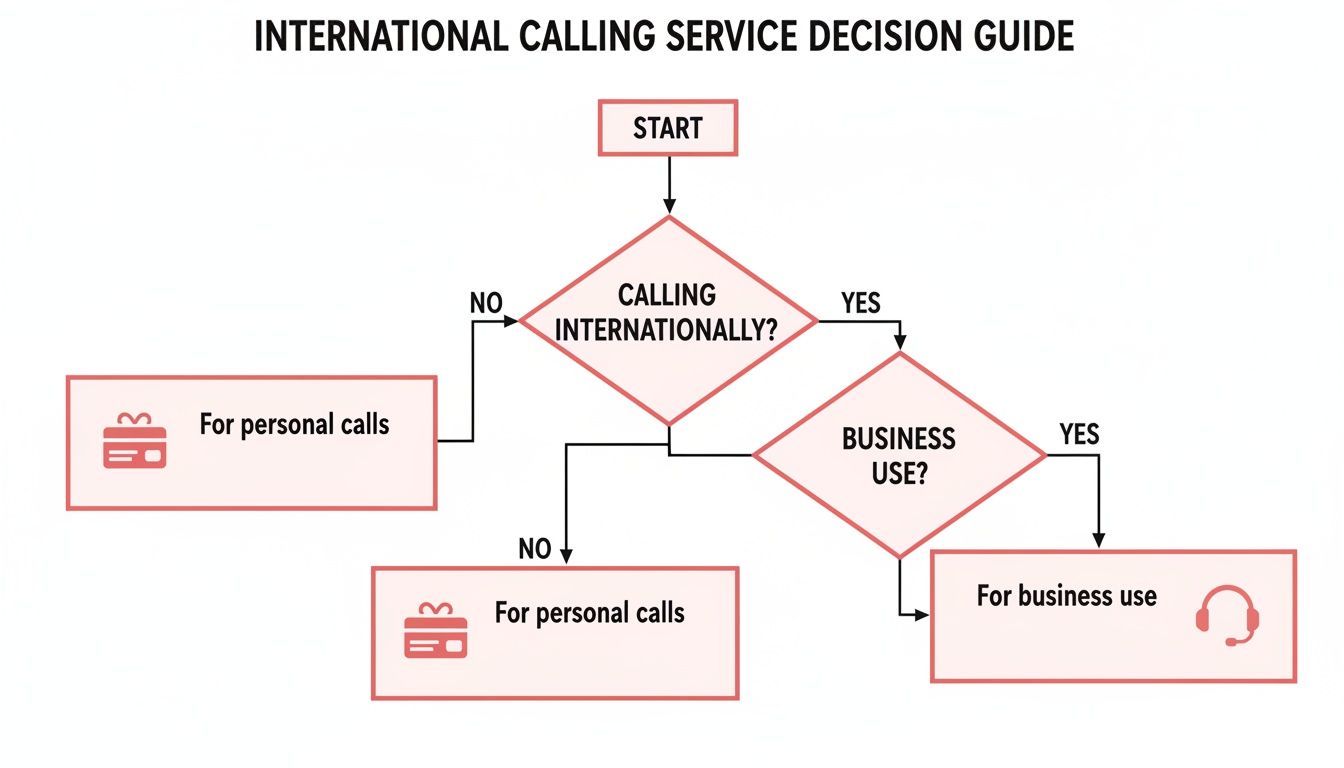
As the flowchart shows, the first question is always "personal or professional?" That single answer changes everything about what you should be looking for.
Now, let's switch gears. You're a small business owner with clients scattered across the globe. Your needs are more complex. It's not just about placing a call; it's about projecting a professional image and managing every client conversation effectively.
For a business, a calling solution must do more than just connect a call. It needs to function as a professional communication tool that builds credibility and streamlines workflow.
The clear winner for a small business owner is a browser-based VoIP platform. Your checklist should include:
A simple calling app just doesn't have the professional tools you need to run a business. A browser-based service like YodelPhone gives you all the necessary features without the headache of a massive enterprise system.
Finally, imagine you're a manager with a team spread across different continents. Your main headache is collaboration and operational efficiency. You need a single, centralized system that keeps everyone on the same page, accountable, and connected, no matter what time zone they're in.
For this scenario, a sophisticated browser-based VoIP platform with deep collaborative features is the only real option. These are your must-haves:
Once you match your profile to the right kind of service, the choice becomes obvious. Whether you're a traveler who values simplicity, a business owner focused on professionalism, or a team leader driving collaboration, there’s a tool built specifically for you.
The search for the best international calling card used to end at a dusty convenience store rack. Today, it ends in your web browser. All the old problems—hidden fees, terrible call quality, and the sheer hassle of access numbers—have been solved by modern VoIP.
YodelPhone is the perfect example of this shift. It goes way beyond just placing a call to offer a complete, professional communication tool. It’s not just a replacement for a calling card; it's a total upgrade designed for how we actually work and connect today. It ditches the prepaid, disposable model for a permanent, feature-rich platform.
This isn't just about convenience. It’s about using technology to have clearer conversations, create smarter workflows, and get predictable costs. For anyone tired of the guessing games with their call credit, YodelPhone is a transparent and far more powerful alternative.
One of the biggest headaches with traditional calling cards was the financial guesswork. You were never quite sure how many minutes you really had after they tacked on connection fees, maintenance charges, and rounded up your minutes.
YodelPhone gets rid of that ambiguity completely. Its pricing is built on being upfront and honest, offering clear per-minute rates to over 180 countries without any hidden costs. You only pay for the time you actually talk, billed by the second, making sure every cent of your credit goes toward the conversation.
But fair pricing is only half the story. The service delivers on what matters most: call quality. By using advanced VoIP technology, YodelPhone provides consistent HD voice clarity. That means no more static, frustrating delays, or dropped calls at critical moments—something that's non-negotiable for professional business calls.
The real power of a modern solution is how it fits into your daily routine. Old calling methods forced you to stop what you were doing, dial an access number, punch in a PIN, and then finally dial the number. YodelPhone brings the entire process right into your browser or desktop app.
This screenshot of the YodelPhone interface shows how every tool you need is in one clean, simple dashboard.

With a single view of your call history, contacts, and dialpad, you can manage all your communications without ever leaving your main workspace.
This browser-based approach means you can start a call with a single click from a website or your CRM. There are no downloads, no separate apps to juggle, and no complicated setup. The entire system is designed to remove friction and save you time, letting you focus on the conversation, not the process of starting it.
By bringing international calling into the browser, YodelPhone transforms it from a clunky, multi-step chore into a seamless, one-click action. This integration is the key difference between a simple calling utility and a true productivity tool.
While a calling card gives you a dial tone, a platform like YodelPhone provides a full suite of tools to manage communications like a pro. These features are designed to help businesses and individuals present a polished, credible image to their international contacts.
That last point is a game-changer. Research shows that branded calling can massively increase call pick-up rates by giving visual proof that a call is legitimate, which cuts down on the time and money spent on follow-up attempts. By moving away from the anonymous nature of traditional calling cards, YodelPhone helps make sure your important calls actually get answered.
Jumping into international calling can feel a little confusing, especially with all the new tech out there. Let's clear the air and tackle the most common questions head-on. This is about giving you straight answers on everything from cost and what gear you need to how your Wi-Fi impacts call quality.
The goal here is simple: cut through the noise so you can pick the right way to make your international calls, whether you're catching up with family or closing a business deal.
In almost every case, yes. VoIP (which stands for Voice over Internet Protocol) services like YodelPhone slash per-minute rates because they send calls over the internet, completely sidestepping the expensive fees charged by old-school phone networks. This is a massive change from how things used to be.
Physical calling cards were the go-to cheap option for years, but they were notorious for hidden costs. You'd buy a card advertised at a low rate, only to see your balance get eaten up by connection fees, "maintenance" charges, and minute rounding. It was a bait-and-switch.
Modern VoIP services, on the other hand, live and die by transparency. You’ll find clear subscription models or straightforward pay-as-you-go rates. This predictability makes them far more cost-effective, especially for any business trying to keep a handle on its budget.
Nope. The best international calling solutions are designed to work with the devices you already have. No special hardware, no extra costs, no complicated setup.
You can make and receive crystal-clear calls a few different ways:
This flexibility is the whole point of modern VoIP. It ditches the need to buy special equipment and lets you run your business communications from anywhere with an internet connection.
Whether you're at your desk, working from home, or traveling, you’re always connected.
Think of your internet connection as the highway your call travels on. For a smooth, professional-sounding VoIP call, you need a stable, high-speed connection. It’s the key to getting that crisp, HD voice quality without any frustrating glitches.
While a basic voice call doesn't hog a ton of bandwidth, a weak or spotty connection will cause problems. You'll run into issues like jitter, which makes audio sound choppy and robotic, or latency, that awkward delay between when you speak and when the other person hears you.
For the best results—especially for an important business call—a solid broadband connection or a strong 4G/5G mobile signal is a must. The top VoIP providers use clever tech to optimize call quality, but at the end of the day, your internet stability is what matters most.
Absolutely. Any reputable VoIP provider built for business, including YodelPhone, offers what's called "number porting." This is the process of moving your existing phone number from your old carrier over to your new VoIP service.
Number porting is a regulated process that ensures you don't lose the phone number your customers already have saved. It allows you to upgrade your phone system to something far more powerful and flexible without confusing your clients or disrupting your business.
By keeping your number, you get to skip the headache of updating your website, business cards, and marketing materials. For your customers, the switch is completely seamless.
Ready to see what a modern, fair-priced alternative to calling cards feels like? YodelPhone delivers crystal-clear international calls right from your browser with honest, pay-as-you-go pricing and zero hidden fees. Start your free trial today and you can be on your first call in seconds.
Discover how international VoIP calls can save you money and simplify global communication. Learn how they work and how to get started in minutes.

Discover voip international calling that delivers clear, affordable global calls from your browser. Learn pricing, setup, and start saving today.
Unlock affordable global calling with a pay as you go international phone service. Learn how to save on calls without contracts or hidden fees.

Discover the cheapest way to make international calls with practical VOIP tips, compare plans, and cut costs while keeping call quality high. Start saving now.