
cheapest international calling rates
Finding the Cheapest International Calling Rates Today

Trying to find the cheapest international calling rates can feel like a wild goose chase. Traditional carriers often hit you with shockingly high per-minute fees, but it doesn't have to be that way. The best deals are almost always found with modern browser-based services, which can connect your calls for as little as $0.02 per minute—a tiny fraction of what the big phone companies charge.
But to really save money, you first have to understand what you're paying for.
That hefty price tag from your mobile carrier isn't just a random number. It's the result of a tangled, decades-old system of backroom deals and clunky infrastructure. When you dial internationally through a major provider, your call hops across multiple networks, and each one takes a cut.
These are called "termination fees"—what one phone company charges another just to connect a call. For international calls, these fees are much higher and far less regulated than domestic ones. The result? A long, expensive chain of markups that gets passed directly to you.
A few key things dictate the final per-minute rate you pay. Knowing them helps you tell a genuine bargain from a cleverly disguised rip-off.
VoIP is what makes cheap calls possible. By sending calls over the internet, services like YodelPhone completely sidestep the expensive, traditional network. This lets them offer drastically lower rates without sacrificing call quality.
Modern calling platforms offer the cheapest international rates because they’ve completely changed how calls are connected. Instead of using the old, expensive network of physical cables, they use the internet. Your call is routed directly and efficiently, cutting out the middlemen and their fees.
This is exactly why a browser-based service can charge a few cents for a call that a legacy carrier might bill at a dollar or more. Let's break down the core differences.
| Feature | Traditional Carriers (e.g., AT&T, Verizon) | Modern Platforms (e.g., YodelPhone) |
|---|---|---|
| Technology | Public Switched Telephone Network (PSTN) | Voice over Internet Protocol (VoIP) |
| Cost Structure | High termination fees, infrastructure costs | Minimal network costs, direct routing |
| Typical Rate (to UK) | $0.20 - $1.50+ per minute | $0.02 - $0.05 per minute |
| Accessibility | Tied to a specific SIM card or landline | Accessible from any device with a browser |
| Billing Model | Requires add-on plans or high pay-per-use | Transparent pay-as-you-go, no contracts |
Once you understand this landscape, it's easy to see why sticking with outdated systems costs you so much. The path to affordable global communication starts with choosing a platform built on modern, cost-effective technology.
Not that long ago, calling another country was a big deal. You'd watch the clock, knowing every minute cost a small fortune. Traditional phone companies—the "legacy carriers"—owned all the infrastructure, and they charged a premium for it. Calling family or a client overseas was a luxury, not an everyday thing.
Behind the scenes, this old system was built on complicated network deals and high "termination fees" that carriers charged each other to connect calls across borders. Of course, they passed those costs straight to you, which is why rates of $1–$3 per minute were normal. But in less than two decades, internet-based calling has completely flipped this model on its head.
The big change was Voice over Internet Protocol (VoIP). Instead of using those expensive, dedicated phone lines, VoIP turns your voice into digital data and sends it over the internet. This simple but powerful idea bypasses all the costly infrastructure that kept the old rates sky-high.
VoIP didn't just lower the price of international calls; it completely changed the economics. By using the internet—a network that's already everywhere—new providers could offer the same service for a tiny fraction of the cost. Global communication went from being an expensive luxury to a cheap utility you can use every day.
The difference in cost is just staggering. A quick ten-minute call to the UK that might have set you back $15 with a traditional carrier now costs less than a dollar with a modern, browser-based service. This isn't just a small discount; it's a fundamental shift in how we think about staying connected.
The real magic of modern calling platforms is that they completely sidestep the clunky, expensive systems of old-school telephony. This is how services like YodelPhone can offer honest, rock-bottom rates without ever skimping on call quality.
The first wave of VoIP services was a step in the right direction, but they often made you download dedicated software and go through a complicated setup. They were cheaper, sure, but not always easy to use.
Today, the best solutions have moved beyond apps entirely. They work right from your web browser. That means no downloads, no installations, and no contracts. You just open a webpage, type in a number, and you’re talking.
This browser-first approach is key to finding the cheapest international calling rates for a few reasons:
This journey from pricey landlines to clunky apps to seamless browser calling has put the power back in your hands. If you want to get into the technical details, check out our guide on how international calling with VoIP works. The ability to connect with anyone, anywhere in the world, for just pennies a minute is now something everyone can access.
Trying to figure out international calling options can feel like a maze. Every method has its own trade-offs between cost, call quality, and sheer convenience. To find the cheapest international calling rates, you have to look past the flashy headline price and dig into what you’re actually getting for your money.
We’re going to break down four of the most common methods: your traditional mobile carrier, those physical calling cards, VoIP apps, and modern browser-based platforms like YodelPhone. This will help you match what you need—whether it’s a quick call to a landline or handling all your business calls—with the option that makes the most financial sense.
Using your regular mobile provider like AT&T or Verizon is definitely the easiest option. You just dial, and the charge shows up on your bill. But you pay a steep price for that convenience.
If you don’t have a special international plan, the per-minute rates can be shocking, often running anywhere from $0.25 to over $2.00. Even if you buy an add-on plan, you’re usually paying a monthly fee for a set number of minutes to only a handful of countries. That’s a terrible deal if your calling needs are spontaneous or you need to reach people in different parts of the world.
For a long time, physical calling cards were the answer for cheap international calls. You’d buy a card with a fixed amount, dial an access number, punch in a ridiculously long PIN, and then finally dial the number you wanted to call. They might advertise low rates, but the real cost is often buried in hidden fees.
These cards are famous for connection fees, "maintenance" charges, and confusing rounding rules that bleed your balance dry. On top of that, the dialing process is a hassle and the call quality is a total gamble, making them feel pretty outdated today.
The biggest problem with calling cards is the lack of honesty. A rate that looks like a bargain on the shelf often ends up costing way more because of a laundry list of fees that are designed to eat up your minutes before you can use them.
Services like WhatsApp, FaceTime Audio, and Viber changed the game by offering free calls between their own apps over the internet. This is a fantastic choice if the person you're calling also has the same app and a decent internet connection.
But here’s the catch: you can't call a real phone number. Need to reach a business landline or a relative who only has a basic mobile phone? You're out of luck. This makes them useless for tons of real-world situations, forcing you to find another way to make any call that isn't app-to-app. These apps are just one of the many cheap ways to call internationally, but they really only work for personal calls within their closed bubble.
This is where the real innovation is. Modern platforms like YodelPhone operate right from your web browser, which means no app downloads, no contracts, and no special equipment. You get the huge cost savings of VoIP technology combined with the dead-simple experience of just dialing a number.
These services give you totally transparent, pay-as-you-go pricing. You see the exact per-minute rate before you even make the call, so there are no surprises. Because the entire system is streamlined, the savings get passed directly to you.
Just look at the massive difference in cost between old-school phone systems and modern browser-based calling.
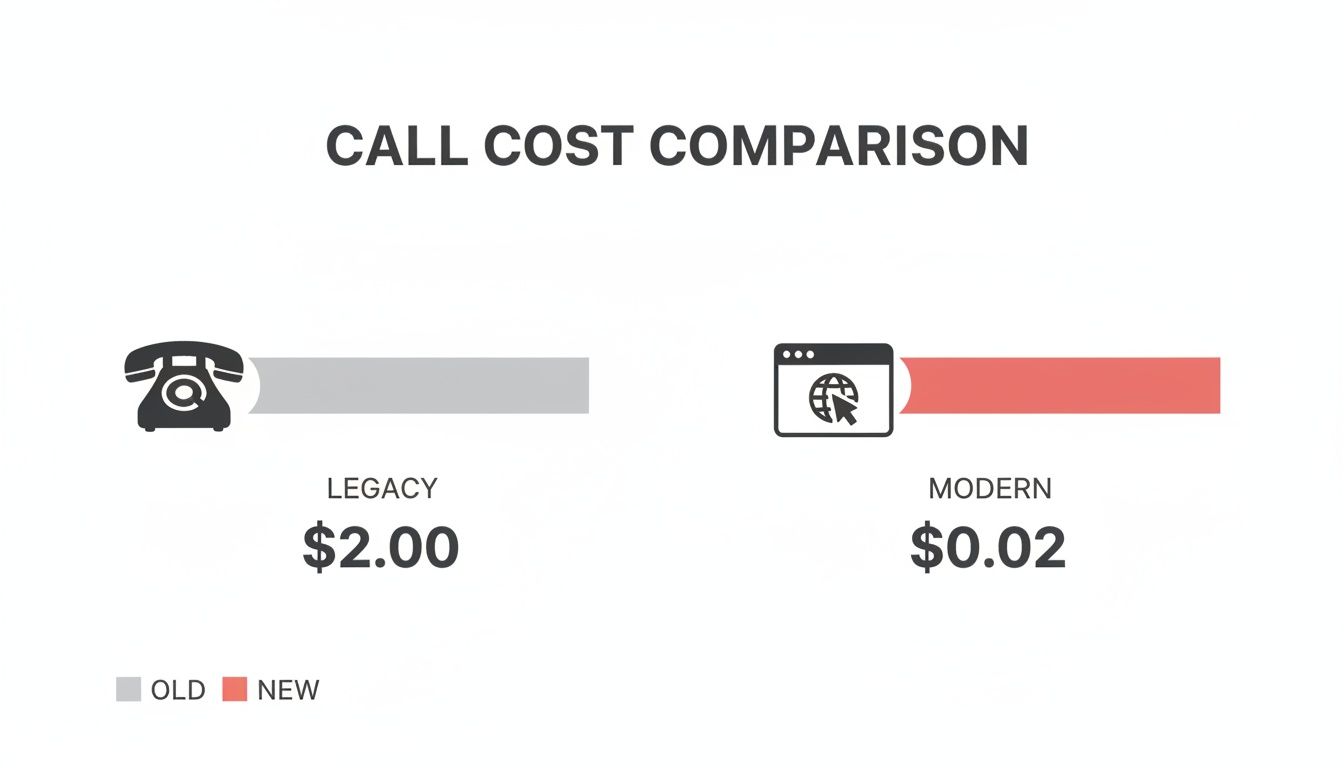
This isn't just a small improvement; it's a monumental shift that makes global communication affordable for everyone. For example, calls to major countries like the U.K., Germany, India, and China often cost just $0.02–$0.05 per minute, for both landlines and mobile phones. Meanwhile, legacy carriers are still charging $0.08–$0.30 per minute for the same calls.
To help you see the differences side-by-side, this table breaks down how each method stacks up across the most important factors.
| Calling Method | Typical Per-Minute Rate (to India/UK) | Setup Complexity | Hidden Fees | Best For |
|---|---|---|---|---|
| Traditional Carrier | $0.25 - $2.00+ | None (built-in) | High roaming fees, plan overages | Emergency calls or users with inclusive plans |
| Calling Cards | Varies (often low advertised) | Low (buy and dial) | Connection, maintenance, and rounding fees | Infrequent callers without internet access |
| VoIP Apps | Free (app-to-app only) | Medium (requires app installation for both parties) | None | Calling friends and family who use the same app |
| Browser-Based (YodelPhone) | $0.02 - $0.05 | Minimal (sign up online in seconds) | None (transparent pay-as-you-go) | Individuals and businesses seeking the lowest rates to any number |
Ultimately, the cheapest option depends on how you make calls. But for the best mix of flexibility, transparent pricing, and rock-bottom costs, browser-based platforms have a clear edge for almost everyone.
For you and me, finding cheaper international calls is about saving a few bucks. But for a small business, a freelancer, or a remote team, that same saving isn't just a minor win—it's a real competitive advantage. Tiny differences in per-minute rates snowball into thousands of dollars a year, freeing up cash that can be put to much better use.
When every dollar counts, pulling money out of an inflated telecom bill and pushing it into marketing, product development, or your team has a massive impact. It's not just about saving money; it's about reallocating it to actually grow the business.
Let’s put it in perspective. The gap between paying $0.25 a minute with a traditional carrier and $0.02 a minute with a service like YodelPhone is 23 cents. That feels small, but it adds up with every single call to an international client, supplier, or team member.
The math here isn't just simple addition; it's multiplicative. For any business with a global footprint, this is impossible to ignore. A company making just 10 hours of international calls per month can save over $30 monthly just by switching providers. That’s $360 a year from one person's phone line.
Now, imagine a 10-person remote team. Even with modest use, you’re suddenly looking at savings that can easily top $3,000 a year. You can dig into more of this data by checking out business communication guides.
This isn't monopoly money. It’s real capital you can reinvest right back into the business.
Smart businesses don't see telecommunications as a fixed cost they just have to accept. They see it as a strategic expense to be optimized. The cheapest international calling rates aren't about pinching pennies—they're about funding your next big move.
For a business, true value goes way beyond the cost of a call. Modern calling platforms are built for how teams actually work today, offering features that old-school phone systems either can't match or charge a fortune for. These tools are designed to make global operations affordable and efficient.
YodelPhone, for example, comes with a few key features that make a huge difference for teams.
Shared Team Credits: Instead of dealing with the headache of individual accounts and expense reports, your entire business can pull from a single, shared pool of calling credits. This makes accounting a breeze, ensures no one's service gets cut off, and gives you a single dashboard to see exactly what's being spent.
Virtual International Numbers: Want to look like you have an office in London or Sydney? A virtual number gives you a local presence in another country. It lets clients there call you at a local rate, making your business feel instantly more accessible and trustworthy. This one feature can dramatically boost inbound leads from global markets without the massive cost of opening a physical office.
At the end of the day, moving to a low-cost, browser-based calling solution is a smart financial decision. It cuts your overhead, simplifies your budget, and gives your team the modern tools they need to compete on a global stage.

Finding a great international rate is only half the battle. What's the point if it takes an hour of downloads, contracts, and confusing setups just to make a call?
Modern calling services like YodelPhone cut through all that noise. You can go from seeing a low rate to dialing a number in literally less than a minute. It all happens right in your browser.
This isn't just talk. We'll walk you through the exact process. The goal is to show you how ridiculously simple it is to test the service, make a real call, and hear the quality for yourself—all without pulling out your credit card.
First things first: setting up your account. This part is designed to be painless. Forget the endless forms and credit checks you get with traditional phone companies. We just need the absolute basics.
The whole process takes about 30 seconds:
That’s it. No hoops to jump through. You’re immediately taken to the calling dashboard, ready to connect with anyone, anywhere.
This is where you see the magic happen. The moment you sign up, you get a free trial to make your first call. No payment info needed. It's a completely risk-free way to make sure the service works perfectly for you.
Once your account is live, your trial credit is waiting. You can use the simple on-screen dialer to place a call right away.
The entire thing—from signing up to hearing the phone ring—happens right in your web browser. There is zero software to install and no app to download. You can call from any computer with an internet connection. This is a massive leap from older VoIP services that forced you to use their clunky apps.
Used your free trial minute? Continuing is just as easy. YodelPhone runs on a straightforward pay-as-you-go model. Simply add credits to your account when you need them, and you only ever pay for the minutes you actually use.
Your dashboard gives you a crystal-clear view of your call history, the per-minute rate for any country, and how much balance you have left. This total transparency means you’re always in control of what you spend.
And if you're looking for more ways to save, check out our guide on how to make an international call for free for other tips and tricks.
By killing off contracts and complicated setups, YodelPhone makes cheap, high-quality international calling a real option for everyone.
Even when you know the options, a few questions always pop up when you're hunting for the absolute cheapest way to call abroad. Let's clear up the common sticking points so you can make a choice with total confidence.
This is the biggest fear, and it’s a valid one. We all remember the bad old days of cheap calling cards with constant echoes, delays, and dropped calls. But that’s ancient history.
Modern VoIP technology has completely changed the game. Today, there is no link between low prices and low quality.
The clarity of your call really comes down to just two things: the provider's network and your own internet connection. A top-tier browser-based service like YodelPhone invests heavily in high-quality call routing to make sure your connection is rock-solid. As long as you have a stable internet connection (even a standard mobile data signal is usually plenty), your calls will be just as clear—if not clearer—than with a traditional phone company.
The bottom line is you no longer have to pick between saving money and having a clear conversation. The best modern platforms give you crystal-clear audio and rock-bottom rates at the same time.
Hidden fees are the bane of international calling, especially with physical calling cards and some legacy providers. The only way to completely avoid them is to pick a service that’s built from the ground up to be transparent.
Here’s what to look for in a provider you can trust:
Services that stick to these rules have nowhere to hide extra fees. The price you see is the price you pay, period. That's the only way to find cheap international rates you can actually count on.
Yes, but this is a massive difference between services. Free apps like WhatsApp or FaceTime Audio are great for calling other people who have the exact same app. But they're totally useless for reaching a real phone number.
This is where browser-based calling platforms really shine. They act as a bridge, letting you call any number on the planet, including:
That flexibility is a game-changer for both personal and business calls. You can connect with anyone, anywhere, without ever having to ask, "Do you have this app?" The platform does all the heavy lifting, connecting your internet call to the traditional phone network seamlessly.
Finding the cheapest rate isn't about a single magic number—it's about seeing the pattern. Prices vary a lot by country and the tech used, but one trend is undeniable: online, browser-based services are consistently the cheapest.
For example, our country guides show that these modern services typically charge between $0.02–$0.05 per minute for calls to major destinations like the U.K., Germany, India, and China, for both mobiles and landlines. Rates to India often hover in the $0.02–$0.04 range, and China is usually around $0.02–$0.05 per minute.
Compare that to old-school business phone systems or traditional carriers, which often charge $0.08–$0.30 per minute for calls to places like the U.K. or Japan. You can explore more data on these rate comparisons to see just how wide the gap is.
Absolutely not. This is one of the best parts about modern calling platforms. The top services are entirely browser-based, which means you don't have to download any software, install a clunky app, or buy a special VoIP desk phone.
All you need is a device with a web browser and an internet connection. Your laptop, desktop, tablet, or smartphone will work perfectly. The entire system—the dial pad, your contacts, your call history—lives on a secure webpage. This makes getting started ridiculously fast and removes all the technical headaches, putting cheap, high-quality international calling in everyone’s hands.
Ready to see how simple it can be? With YodelPhone, you can be making crystal-clear, affordable international calls in less than 60 seconds. Sign up today for a free trial—no credit card needed—and discover just how easy global communication should be.
Unlock affordable global calling with a pay as you go international phone service. Learn how to save on calls without contracts or hidden fees.

Discover how to make international calls cheap using modern, simple methods. This guide covers the best apps, smart strategies, and common pitfalls to avoid.

Discover the best cheap way to make international calls. This guide compares VoIP, calling apps, and SIMs to help you connect globally without overspending.

Discover how to make cheap international calls from any device. Our guide explores the best apps, VoIP services, and tips for clear, low-cost calling.