
best way to call overseas
Best Way to Call Overseas: Cheap, Reliable Options for Worldwide Calls

Let's be honest: calling someone overseas shouldn't be complicated or expensive. But somehow, it still is. Between sky-high carrier fees, confusing international plans, and calls that sound like you're underwater, it's easy to get frustrated.
If you're trying to connect with family, friends, or clients abroad without breaking the bank, you're in the right place. This guide cuts through the noise and compares the real-world options available today—from your mobile carrier to modern VoIP services.
Our goal is simple: to give you the clarity you need to pick the best way to call overseas. Whether you’re a student studying abroad, a business owner with global clients, or just catching up with loved ones, there’s a solution that fits.
For years, the go-to options were either sticking with your traditional phone carrier or fumbling with a calling card. Both come with major headaches. Carriers often lock you into pricey monthly add-ons or hit you with shocking per-minute rates that turn a quick chat into a hefty bill.
Calling cards seemed like a cheap fix, but they’re notorious for hidden connection fees and minutes that vanish into thin air.
The real issue here is the lack of transparency and flexibility. You're either locked into a plan that doesn't fit how you actually make calls or get blindsided by unexpected charges.
It's this exact frustration that has fueled the rise of better alternatives. The global market for international calling services is already worth $1.58 billion and is expected to climb to $2.38 billion. Why the boom? A 34% spike in international travel has created a massive demand for communication that’s both affordable and reliable.
| Calling Method | The Hidden Catch | Who It's Really For |
|---|---|---|
| Mobile Carrier Plan | Exorbitant costs and rigid contracts. | People who rarely call abroad and don't mind paying a premium for convenience. |
| Calling Cards | Hidden fees, expiring minutes, and inconvenient PINs. | One-off emergency calls when you don't have a smartphone or internet. |
| Browser-Based VoIP | Needs a decent internet connection. | Frequent callers who want the best rates, flexibility, and business-grade features. |
This is why it’s so important to understand how to make international calls with modern tools. The right choice comes down to your specific needs, balancing cost, convenience, and call quality.
When you need to call someone overseas, a quick look at your options can feel overwhelming. Every method, from your old-school mobile carrier plan to slick new browser-based tools, comes with its own set of trade-offs. The trick is to look past the marketing noise and figure out what actually works for you.
This section breaks down the four main ways to call internationally. We’ll get into the real-world pros and cons of each, helping you match a solution to your calling habits—whether you’re making one crucial call a month or managing global communications every day.
The need for clear, affordable international calling isn't going away. In fact, it's growing, driven by global business and families living oceans apart.
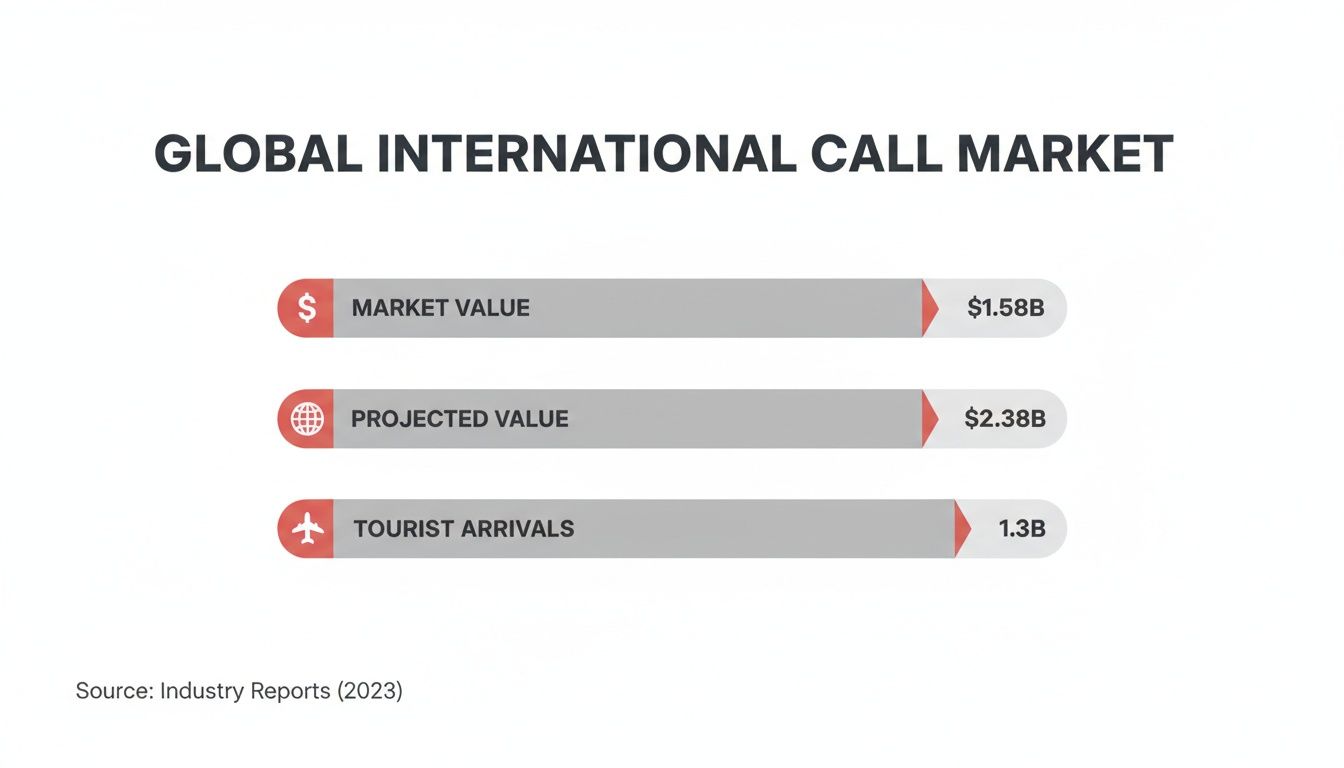
As you can see, the market's growth is directly tied to the rising number of people traveling, working, and staying connected across borders.
Using your existing mobile or landline provider is the default option for many. It's familiar—you just dial the number and it works. But this convenience almost always comes with a hefty price tag.
Carriers typically use two pricing models for international calls:
The biggest issue here is the cost. Even with a plan, you're paying a recurring fee whether you make calls or not, and the "discounted" rates are almost never the cheapest you can find.
Apps like WhatsApp, Skype, and FaceTime have completely changed the game for many. They run on Voice over Internet Protocol (VoIP), sending your call over the internet instead of through traditional phone lines.
Their main draw? App-to-app calls are usually free, no matter where you are in the world. As long as you and the person you're calling both have the same app and a decent internet connection, you can chat for hours without a single charge.
The problem arises when you need to call a regular phone number—like a landline or a mobile phone without the app. While some apps offer this, the per-minute rates can be surprisingly high, and the call quality can be a gamble. For a deeper dive, check out our guide to the best international calling apps.
App-based services are fantastic for connecting with other users inside their digital bubble. They fall short when you need a universal tool to reach any phone number on the planet—a must-have for businesses or anyone calling older relatives.
Remember these? Before smartphones took over, physical calling cards were the budget-friendly choice. You’d buy a prepaid card, dial an access number, punch in a long PIN, and then finally dial the number you wanted to reach.
While you can still find them, their time has largely passed. The process is clunky, and the advertised low rates are often a bait-and-switch. Hidden connection fees, maintenance fees, and other surcharges drain your balance much faster than you’d expect.
Honestly, their only remaining use case is for someone without a smartphone or internet who needs to make a one-off call from a landline. For everyone else, modern options are far more transparent and user-friendly.
The newest and most flexible option is browser-based VoIP, the technology behind platforms like YodelPhone. This approach takes the best parts of app-based services (low cost) and traditional calling (reliability) without forcing you to download any software. You just log into a website on your computer or phone and start dialing.
This method delivers some clear wins:
This blend of cost savings and reliability is making browser-based VoIP the smartest option for most international calling needs. The global call market is set to grow from $1.44 billion to $2.29 billion by 2032, with VoIP leading the charge. As businesses save 60-90% by ditching old-school carriers, the move to flexible cloud solutions is becoming a no-brainer.
To help you see the differences side-by-side, here’s a quick rundown.
This table breaks down the key factors for each method, giving you a high-level view to help you decide which one fits your needs best.
| Method | Average Cost | Best For | Setup Complexity | Requires Downloads |
|---|---|---|---|---|
| Carrier Plan | Very High | Emergencies, infrequent calls | None | No |
| App-Based VoIP | Free (app-to-app) | Calling other app users | Medium | Yes |
| Calling Card | Low (but with hidden fees) | No smartphone or internet | High | No |
| Browser-Based VoIP | Very Low | Calling any number frequently | Low | No |
Ultimately, the best way to call overseas comes down to who you’re calling and how often. For the most flexibility, honest pricing, and the freedom to reach any phone number from any device, browser-based VoIP is clearly the most practical and modern solution.
Knowing the options is one thing, but picking the right one comes down to your real-world needs. The best way to call overseas isn't a one-size-fits-all answer.
What works for a student calling home once a week is completely different from what a small business needs to manage a global client base. Let's break down a few common scenarios to see which solution fits best.
Picture this: you're studying abroad or living in a new country. Your main goal is staying connected with family and friends back home without racking up a massive bill. You’re making frequent, often long, calls to the same few numbers.
Cost and flexibility are everything here. Your mobile carrier’s international plan? Way too expensive for regular, long chats. An app like WhatsApp is great, but it’s a non-starter when you need to call your grandmother's landline.
This is where a browser-based service like YodelPhone really shines. It gives you the dirt-cheap per-minute rates of VoIP with the power to call any number on the planet, landline or mobile.
Recommendation Breakdown:
Now, think about the constant traveler—the digital nomad, consultant, or globetrotter. Your challenge is making calls from different countries, often with spotty hotel Wi-Fi, to reach hotels, tour guides, or clients.
Relying on your home carrier's roaming package is a surefire way to get a shocking bill. And let's be honest, buying a new local SIM card in every country is a total pain. App-based services are handy, but again, they fail the moment you need to call a local business that isn’t on the app.
For the frequent traveler, the priorities are reliability and affordable access from anywhere. The real freedom comes from a solution that isn't tied to one device or SIM card.
Browser-based VoIP is the clear winner here, too. As long as you can find an internet connection—whether it's at a café, in your hotel, or from a local data plan—you can log in and make calls at the same low rates. This completely sidesteps roaming fees and gives you one consistent platform for all your calls, no matter where you are in the world.
A small business or freelancer with international clients plays by a different set of rules. For you, communication isn't just about staying in touch—it's about projecting professionalism, ensuring reliability, and building trust.
A dropped call or your personal mobile number popping up on a client’s caller ID can instantly damage your credibility. You need more than just low rates; you need features that make you look like a pro.
Key Features for Businesses:
International calling is non-negotiable for business, and VoIP is taking over. The market hit $35.5 billion and is expected to climb to $47.9 billion by 2031. This boom is driven by businesses using platforms like YodelPhone to set up a local presence without a physical office. For sales and support teams, using local virtual numbers can boost call answer rates by 25-40% because people are just far more likely to answer a familiar area code.
For a business, browser-based VoIP isn't just an option; it's the smartest choice. It combines the affordability you need with the professional features you can't live without, turning what used to be a costly headache into a serious business asset.
Alright, enough with the comparisons. Let's get down to business and show you just how easy it is to actually place a call with a service like YodelPhone. Forget about complicated downloads, installations, or giving away your credit card info just for a trial.
YodelPhone is designed to be ridiculously simple. The entire thing works right from your web browser, which means you can go from reading this article to talking to someone across the globe in about 60 seconds.
First things first: creating an account. This part is completely frictionless. Unlike most services that demand your credit card for a "free trial," YodelPhone lets you get started without any strings attached.
This "try before you buy" approach is a huge deal. You get to test the call quality and see how easy the platform is to use with zero risk. You can confirm it works perfectly for you before spending a single penny.
The ability to make a real, one-minute international call without providing payment information is a key differentiator. It shows confidence in the service's quality and puts you in complete control from the very beginning.
This is the clean, simple interface you’ll see right after you sign up. The dialer is ready to go.
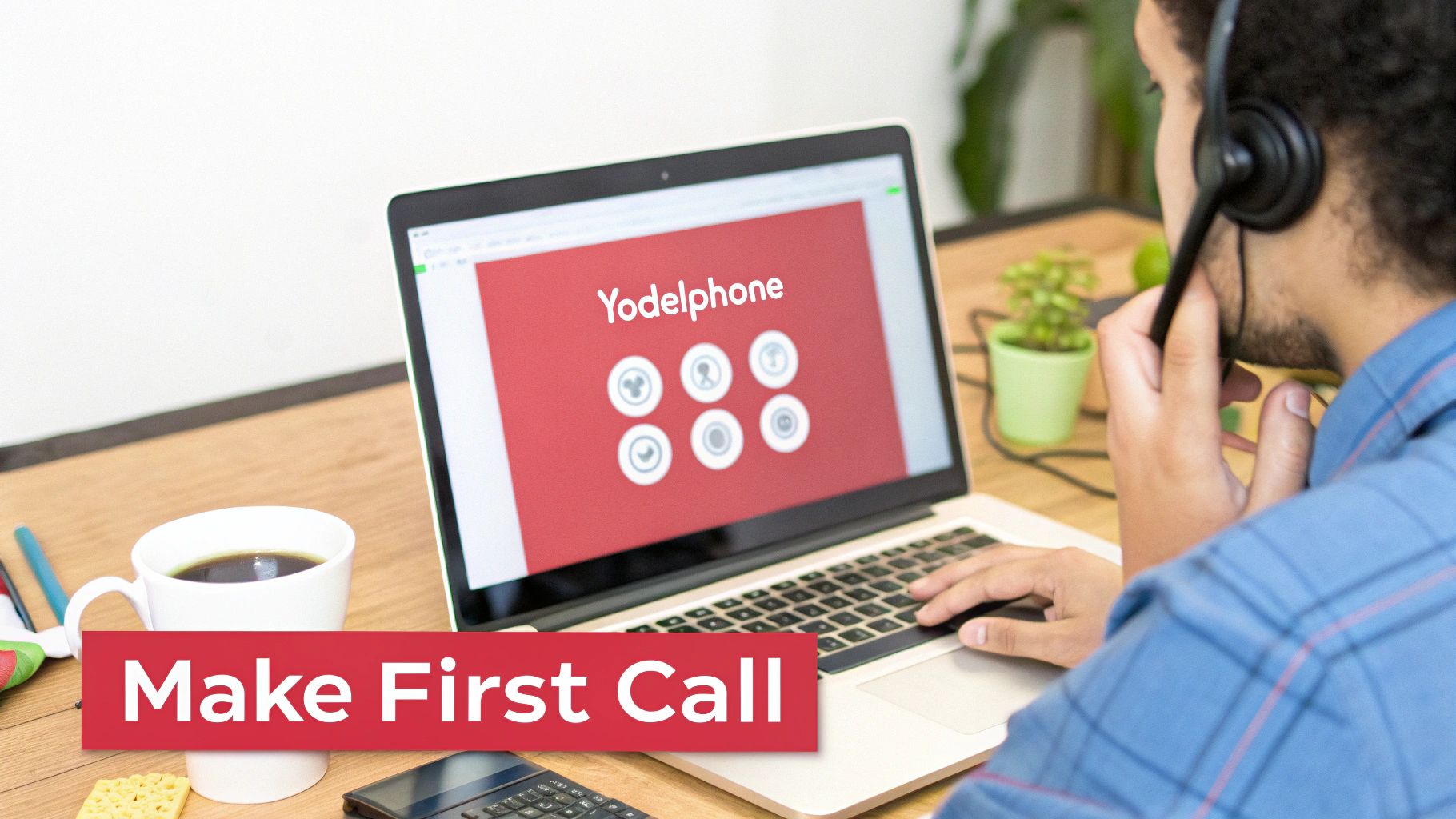
The whole point is clarity and immediate action. You shouldn’t need a manual to figure out how to dial a number.
With your trial active, you're ready to make the call. It works just like a regular phone, but it’s all happening in your browser.
To dial an international number, you usually need three pieces:
YodelPhone makes this even easier. You just select the country you’re calling from a dropdown menu, which handles the country code for you. Then, just type in the local number and hit the call button. Simple.
After you’ve made a successful trial call and confirmed the quality is great, you’ll probably want to keep using the service. YodelPhone runs on a straightforward pay-as-you-go model, which is why it’s a favorite for anyone who hates subscriptions.
There are no monthly fees, no hidden charges, and no contracts. You just add funds to your account, and the cost of your calls gets deducted from that balance. The per-minute rates are completely transparent, so you always know exactly what you're paying. You are in total control of your spending.
If you’re running a business, you can create a team account and share credits from one central billing source. This makes it incredibly easy to track expenses and manage communication budgets for multiple team members without any hassle.
Picking the right service is a great start, but becoming a savvy international caller is what really saves you money and headaches. A few simple tweaks to your setup and habits can dramatically cut costs and improve your call quality, no matter which method you use. This is how you go from just making calls to making them smart.
These are the tips I share with everyone, from solo travelers to small business owners. They're universal, but they pack an extra punch when you're using a flexible service like a browser-based VoIP.
This is the sneakiest way companies overcharge you. Not all per-minute rates are the same because of one tiny detail: the billing increment. Are you paying by the second or by the minute? The difference adds up fast.
A service that bills by the second respects your money. Over dozens or hundreds of calls, this can translate into substantial savings, especially for businesses making frequent, brief check-in calls to clients or suppliers.
When you use VoIP, your internet connection is everything. A spotty or slow connection is the #1 culprit behind dropped calls, annoying echoes, and garbled audio. You don’t need lightning-fast speeds, but stability is non-negotiable.
For the best way to call overseas with VoIP, try these simple fixes:
These little adjustments can be the difference between a frustrating, choppy conversation and one that’s crystal clear.
For businesses, international calling isn’t just about talking—it's about managing relationships and tracking every dollar. Modern calling platforms come with tools built for exactly that.
YodelPhone’s team dashboard, for example, lets a manager add multiple users who all share from a single credit balance. This completely centralizes billing and gets rid of the nightmare of reimbursing employees for their international call expenses. You can see detailed call logs, track usage per team member, and make sure your budget is being spent wisely.
You also get call analytics that show you which countries you're calling most. That kind of data is gold for business strategy. While free apps are great for casual chats, they rarely offer these critical business features. In fact, if you're thinking about using WhatsApp for business, you should know that WhatsApp can't call landlines—a major roadblock for any professional outreach.
Here’s one of the most powerful tools for any international business: a virtual number. It's a local phone number for a country where you aren't physically located, and it forwards all incoming calls right to your primary phone, wherever you are.
Getting a virtual number in a key market—say, the UK or Germany—is a game-changer. It lets clients in that country call you at a local rate, which instantly builds trust. People are far more likely to answer a call from a familiar local number and are much more willing to dial it themselves. It removes both the financial and psychological barrier of making an international call.
Got a few lingering questions? Perfect. Let's tackle the common sticking points people run into when deciding on the best way to call overseas. We’ll keep the answers clear and straight to the point.
Yes, you can—but this is one of the biggest "gotchas" that trips people up. It's a critical difference between the various calling methods out there.
While apps like WhatsApp are fantastic for chatting with other app users, they hit a wall when you need to reach a traditional phone number. They simply can't do it. A browser-based VoIP service, on the other hand, is designed specifically to bridge that gap. It works just like a regular phone, letting you dial any standard number in the world, whether it’s a mobile or an old-school landline.
This flexibility is non-negotiable for businesses trying to reach clients or for anyone calling family members who aren't glued to the latest apps.
It’s a fair question, especially when you're dealing with sensitive client information. The short answer is yes. Modern VoIP platforms are built with professional-grade security from the ground up.
Reputable services use strong, end-to-end encryption to scramble and protect your call data as it travels over the internet. This prevents anyone from snooping on your conversations. For any serious business, this isn't just a nice-to-have feature—it’s a core requirement for protecting client privacy and your own company's data.
When you're picking a service, always look for the phrase "end-to-end encryption." It’s your guarantee that your business conversations will stay private and meet the security standards you'd expect from any professional tool.
This makes a quality browser-based VoIP a totally secure and reliable choice for everything from confidential client calls to internal team meetings across different countries.
Think of a virtual number as a phone number that lives in the cloud, completely untethered from a physical phone line or a SIM card. You can set it up to forward incoming calls to any device you want, anywhere in the world.
For businesses, this is a game-changer. Imagine you could buy a local phone number in London for your UK customers, even if your office is in New York.
Suddenly, you get two massive advantages:
A virtual number gives you an instant local presence in a foreign market, all without the headache and cost of setting up a physical office.
Hidden fees are the bane of international calling. They’re the reason old-school methods like physical calling cards and some carrier plans feel so scammy. Sneaky charges like "connection fees" or rounding up your call time to the next full minute can destroy your budget.
The best defense is a good offense: choose a service with a completely transparent pricing model. You want to look for a pay-as-you-go system where you can see the exact per-minute rate for any country before you even dial.
Services like YodelPhone are built on this exact principle. You'll find no surprise connection fees, no monthly subscriptions, and no minimum spending traps. Your calls are billed by the second, not rounded up, so you only pay for the time you actually talk. That kind of clarity means your costs are always predictable and fair.
Ready to see how simple and transparent international calling can be? YodelPhone lets you make crystal-clear calls right from your browser in seconds. Try it completely risk-free with a one-minute trial call—no credit card needed. Get started at https://yodelphone.com.

Try a free international call trial instantly in your browser - no downloads or card required. Test call quality and connect globally in seconds.
Unlock affordable global calling with a pay as you go international phone service. Learn how to save on calls without contracts or hidden fees.

Discover the cheapest way to make international calls with practical VOIP tips, compare plans, and cut costs while keeping call quality high. Start saving now.

Discover how to make cheap overseas calls with simple, proven methods. Our guide covers VoIP, browser calling, and tips to slash your international bill.