
how to reduce phone bills
How to Reduce Phone Bills: how to reduce phone bills with simple tips

If you're serious about cutting your phone bill, you can't just guess. You need a strategy, and that strategy starts with a cold, hard look at your usage.
It’s about analyzing your actual data, minute, and text habits to stop paying for things you simply don't need. This evidence is your ammo—it's what you'll use to negotiate a better rate or confidently jump ship to a plan that actually fits your life.
Before you can slash your bill, you have to play detective. Your monthly statement is packed with clues, but most of us just glance at the total and pay it. To find real savings, you need to dig in and see exactly where every dollar is going.
This isn't about building complicated spreadsheets. It's about asking simple questions and finding the answers right there in your bill and usage history.
The goal here is to establish a clear baseline. Are you on a pricey unlimited data plan but barely crack 5 GB a month? Are you paying for premium international calling features you've never once used? An audit brings these expensive mismatches to light.
Think of your phone bill as a report card on your spending. Grab your last two or three statements—paper or digital—and start hunting for these specific line items. Don't just skim them; really scrutinize each one.
A classic mistake is the "set it and forget it" mentality. A family signs up for a top-tier plan with four lines, paying for unlimited everything. They later find out two family members are almost always on Wi-Fi and use less than 3 GB of data each. That single insight could justify moving them to a much cheaper plan, saving hundreds of dollars a year.
Once you've dissected your past bills, it's time to monitor your usage in real-time for one full billing cycle. This gives you the most accurate snapshot of your needs, whether you're a solo user or managing phones for a small team.
Set a weekly reminder to check your usage dashboard. Most carrier apps or websites offer a detailed breakdown. You might be surprised to find your data usage spikes on weekends or that your call minutes are way lower than you thought, especially with the rise of VoIP and Wi-Fi calling.
For those looking to ditch traditional call costs entirely, our guide on free internet phone services offers some powerful alternatives.
By the end of the month, you’ll have a clear, data-backed summary of what you actually need. This information is your single most powerful tool for what comes next, empowering you to choose a plan that fits you—not the other way around.
Now that you have a clear picture of your actual usage, you're in control. It's time to stop overpaying for a bloated plan and find a carrier that actually fits your needs and budget. The mobile world is much bigger than just the three major providers, and looking beyond them is often the fastest way to slash your phone bill.
Plenty of people are already making this move. A recent survey showed that 43% of respondents actively took steps to cut their phone bills last year. What was the top strategy? Switching providers, which 32% of people did to escape overpriced plans. Others focused on using Wi-Fi more (31%) and ditching unnecessary add-ons (29%), according to the full NumberBarn phone bill report.
The audit you just did is the crucial first step before you start comparing carriers. It gives you the power.
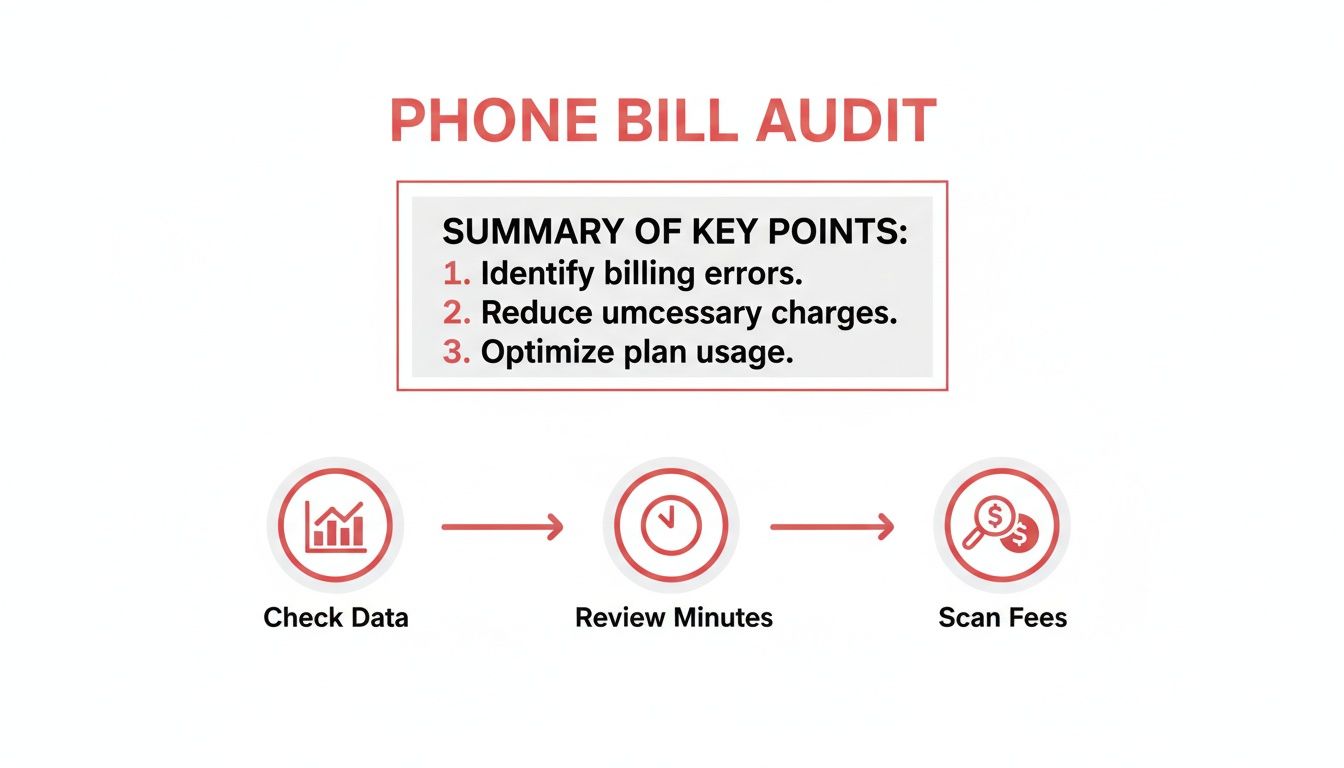
This process—checking your data, reviewing minutes, and scanning for hidden fees—arms you with the exact information needed to choose a new plan wisely.
The biggest names in mobile aren't always the best value. Let me introduce you to Mobile Virtual Network Operators (MVNOs). These smaller carriers lease network access from the major players like AT&T, Verizon, and T-Mobile and then resell it to you at a much lower cost.
Because they don't have the massive overhead of maintaining their own physical towers, they pass those savings directly to you. In most cases, you get the exact same coverage and reliability for a fraction of the price.
Here are a few types of plans to look for:
By switching from a major carrier’s unlimited plan to an MVNO with a 10 GB cap, someone who never even uses 8 GB of data per month could easily save $30-$50 every single month. That's up to $600 a year for the same quality of service.
To help you decide which approach is right for you, here’s a quick breakdown of common strategies.
| Strategy | Potential Monthly Savings | Best For |
|---|---|---|
| Switching to an MVNO | $30 - $60 | Individuals and families tired of overpaying the major carriers. |
| Choosing a Low-Data Plan | $20 - $40 | People who are almost always connected to Wi-Fi at home or work. |
| Negotiating with Current Carrier | $10 - $25 | Loyal customers who are generally happy but want a better rate. |
| Dropping Phone Insurance | $7 - $15 | Users with older phones or who are careful with their devices. |
| Using VoIP for Calls | $5 - $50+ | Small businesses and anyone making frequent international calls. |
Each of these tactics offers real savings, but combining a few—like switching to an MVNO and choosing a low-data plan—can lead to the biggest impact on your monthly bill.
The choice between prepaid and postpaid really boils down to control versus commitment. Postpaid plans are the traditional model where you’re billed at the end of the month for what you used. They often dangle perks like phone financing, but they almost always lock you into a contract.
Prepaid, on the other hand, puts you in complete control. You pay in advance, so there are no surprise overage charges and no bill shock at the end of the month.
The flexibility of prepaid is its biggest draw; you can change your plan month-to-month as your needs change without any penalties. This freedom is a key reason why so many people are looking into the best no-contract phone service options available today.
For a small business, this kind of flexibility is a game-changer. You can give team members plans that match their specific roles—a high-data plan for a field agent and a low-data plan for an office-based employee—without getting locked into a rigid, one-size-fits-all corporate contract. It’s a simple way to ensure you only pay for what your team actually uses.
Data overages are the silent killers of a monthly budget. One minute you're fine, the next you've streamed a couple of unexpected videos, a background update ran on cellular, and boom—your bill is suddenly way higher than you expected. Getting a handle on your data is one of the quickest ways to permanently lower your phone bill.
This goes way beyond the generic advice to "just use Wi-Fi." To really see a difference, you need to get proactive about how your phone burns through data, especially when you're not even looking at it. So many apps are constantly syncing, refreshing, and downloading in the background, quietly eating up your precious gigabytes.
Your first mission is to figure out which apps are actually causing the damage. Both iPhones and Androids have a built-in cellular data monitor that shows you an exact, app-by-app breakdown.
You can usually find it under Settings > Cellular (or Mobile Data). Just scroll down, and you'll see a list of every app and precisely how much data it's used this billing cycle. Be prepared for a few surprises—you might find a social media app you barely open is a major offender because of all its background activity.
Once you’ve found the culprits, you can take action. For any non-essential app that’s using way too much data, just toggle off its access to cellular data. Simple. Now, it can only update or download when you're safely connected to Wi-Fi.
Beyond policing individual apps, a few system-wide settings can make a huge impact. Think of these as a "set it and forget it" way to protect your data allowance 24/7.
Pro Tip: Get in the habit of downloading what you need before you leave the house. Download playlists from Spotify, episodes from Netflix, and offline maps on Google Maps while you're on Wi-Fi. You get everything you need without touching your cellular plan.
For yourself or a small team, you can't afford to wait for the monthly bill to discover a problem. Don't be reactive. Most carriers have an app or online portal where you can check your data usage in real-time.
Take it one step further and set up usage alerts. Nearly every provider will let you get a text or email when you've hit 75% or 90% of your monthly limit. That warning shot gives you enough time to ease up for the rest of the billing cycle and dodge those overage fees.
The growth in mobile data use is insane—global consumption is on track to hit 200 exabytes per month, thanks to data-hungry apps and 5G. This makes smart tactics like Wi-Fi offloading essential. In fact, 31% of people who successfully cut their phone bills did it this way, which can slash cellular data use by 40-60% and prevent $15-$30 in average monthly overages. You can dig into more of these numbers by checking out these mobile data statistics.
International calling and data roaming are two of the fastest ways to blow up an otherwise reasonable phone budget. I've seen it happen time and time again—one trip abroad or a few calls to family overseas can rack up charges higher than your entire monthly plan. For years, traditional carriers have treated these as premium services, slapping on shockingly high per-minute or per-megabyte rates.
The good news? You don't have to be at their mercy anymore. Modern tech, especially browser-based Voice over Internet Protocol (VoIP) services, offers an incredibly powerful and affordable way out. These tools simply route your calls over the internet instead of old-school phone lines, neatly sidestepping the crazy fees carriers charge to connect across borders.
This one simple shift can slash your costs, turning what used to be a major headache into a minor, predictable expense. It's a must-know strategy for anyone serious about cutting down their phone bill while staying connected globally.
The absolute easiest way to dodge high international call rates is to stop using your carrier's network for those calls entirely. Browser-based VoIP platforms like YodelPhone let you make crystal-clear calls directly from your computer, tablet, or smartphone to over 180 countries. And the best part? No special hardware or clunky software downloads are needed.
You just open a web browser, log in, and dial. That’s it. This approach is usually built on a pay-as-you-go model, which is a massive win for your wallet in two ways:
This model puts you back in the driver's seat. Need to make a 10-minute call to the UK? You pay for exactly 10 minutes at a low, advertised rate—no hidden connection fees, no surprise charges.
This screenshot shows just how simple the interface is for making calls right from your browser.
As you can see, it's designed for you to take immediate action. You can dial any number in the world in seconds, without any complicated setup.
For small businesses and teams juggling international clients or colleagues, the savings get even bigger. Traditional business phone plans that include international calling can be incredibly expensive and rigid. VoIP solutions, on the other hand, offer features designed specifically for team collaboration and keeping costs in check.
One of the most useful features is the ability to create a team account with shared credits. Instead of dealing with multiple individual accounts and expense reports, you can load a single pool of funds for the entire team to use. This makes accounting a breeze and ensures everyone has the access they need, when they need it.
On top of that, these platforms provide detailed call analytics. You can easily track call durations, destinations, and costs for each team member. This data is gold for budgeting, monitoring expenses, and understanding communication patterns with your global partners—a level of clarity that traditional phone bills almost never provide. For more ideas, check out our guide on cheap ways to call internationally.
A real game-changer is the ability to buy virtual international phone numbers. A small business in the US can get a local number in Germany, allowing German clients to call them at a local rate. This instantly creates a professional, local presence in a foreign market without the massive expense of opening a physical office.
When you're on the road, data roaming charges can add up with terrifying speed. Instead of paying your carrier $10 per day or more for a travel pass, just use Wi-Fi to your advantage.
Find a solid Wi-Fi connection at your hotel, a café, or a coworking space. From there, you can use a browser-based VoIP service to make calls back home or to local numbers for just pennies per minute. This one simple habit can save you hundreds of dollars on a single trip. It’s one of the most effective tactics out there for anyone wondering how to slash their phone bill while traveling.
Think switching carriers is the only way to slash your phone bill? Think again.
Often, the best deal is hiding right under your nose, and you can get it without the headache of porting numbers or swapping SIM cards. All it takes is a single, well-prepared phone call to the people who want to keep your business the most: your current provider.
This works way more often than you’d expect. Cellular companies spend a fortune acquiring new customers, so they’d much rather give a loyal one a discount than watch them walk over to a competitor. With the right approach, you can often trim 10-20% off your bill in a single conversation.

Walking into this conversation unprepared is the fastest way to get a polite but firm "no." Success here is all about having your facts straight. This isn't about being confrontational; it's about showing them you’ve done your homework.
Before you even think about dialing, get this information ready:
With this data, you're not just asking for a handout. You're presenting a rock-solid business case for why your current plan no longer makes sense for you.
When you call customer service, your first mission is to get past the gatekeeper. The first agent you speak with usually has little power to offer real discounts. You need to talk to the customer retention department, sometimes called the "loyalty" or "cancellations" team.
To get there, use a script that’s polite but direct. After the initial greeting, try this:
"Hi there, I've been a loyal customer for over eight years, and I'm calling because my bill has become too high. I'm considering switching to another provider that has a much better offer, but I wanted to call first to see if there's anything you can do to lower my monthly costs before I make a final decision."
This simple script does two things perfectly: it signals you're a valuable, long-term customer, and it makes it clear you're ready to leave. That's usually the magic phrase to get you transferred to a retention specialist who can actually make things happen.
Once you're speaking with the right person, calmly lay out your case. Mention your loyalty, cite the specific competitor offer you found, and explain how your current plan is overkill for your usage.
From there, start asking about specific, often unadvertised, ways they can help. Be direct.
The key is to stay friendly but persistent. If their first offer isn’t good enough, it’s fine to say, "I appreciate that, but it still doesn't quite match the offer from XYZ Mobile. Is there anything else you can do?"
By remaining courteous and firm, you position yourself as a reasonable person they want to keep. And that makes it far more likely they’ll find a way to give you a price you’re both happy with.
Even with a solid game plan, you're bound to have a few questions. Real-world situations can be messy, and it’s smart to think through the details before making a move.
Let's tackle some of the most common things people ask when they're trying to slash their mobile expenses. These are the practical, no-fluff answers you need to move forward and make the right call for your wallet.
This is the number one worry for most people, but the answer is almost always no. Here's why.
Smaller carriers, often called MVNOs (Mobile Virtual Network Operators), don't build their own cell towers. Instead, they just lease network access from the big guys—Verizon, AT&T, and T-Mobile. You're getting the exact same signal, same coverage, and same call quality you're already used to, just without the premium price tag.
The only thing you need to do is check which major network an MVNO runs on. If Verizon works best in your area, just find an MVNO that uses the Verizon network. It's that simple.
You’re buying the same core service without paying for the big brand's massive marketing budget. For most people, the day-to-day experience is identical, but the monthly savings are huge.
Financially speaking, buying your phone outright is almost always the smarter move in the long run.
When you finance a phone through a major carrier, you’re usually shackled to a two- or three-year contract with a pricey postpaid plan. That "free" or "discounted" phone isn't a gift; its cost is just baked into the higher monthly fees you're paying over and over.
But when you own your phone, you hold all the power. You can jump to any cheap, contract-free prepaid plan you want, whenever you want. This freedom lets you hunt for the best deals on the market, which can easily save you hundreds of dollars over the life of your device.
Yes, the upfront cost is higher, but the long-term savings from those much cheaper monthly plans make it a no-brainer. Think of it as a one-time investment that unlocks years of lower bills.
It's a great habit to give your plan a quick check-up at least once a year. Your life can change a lot in twelve months. Maybe you switched to a remote job and are always on Wi-Fi, or maybe your data usage has shot up.
An annual review ensures you’re not paying for things you don't need anymore. It's also the best way to catch "bill creep," where tiny fees and surcharges slowly inflate your costs without you noticing. Plus, carriers are constantly rolling out new, more competitive plans, and you won't hear about them unless you look.
Just set a calendar reminder. It’s a simple 15-minute task that can put serious money back in your pocket.
Forget your mobile carrier. The simplest and cheapest method is to use a browser-based VoIP (Voice over Internet Protocol) service.
These tools let you make calls directly from your computer or smartphone using the internet, often for just pennies a minute. This completely sidesteps your carrier and helps you avoid:
You pay for exactly what you use, with no hidden catches. It’s the modern way to solve an old problem, giving you total clarity and control over what you spend.
Ready to stop overpaying for international calls? With YodelPhone, you can call family, friends, and clients in over 180 countries right from your browser—no downloads or contracts needed. Get started in seconds and see how simple global communication can be.

Try a free international call trial instantly in your browser - no downloads or card required. Test call quality and connect globally in seconds.

Uncover what is VoIP and how does it work with this clear, step-by-step guide. Learn the basics, benefits, and how to start making calls over the internet.

Discover how international VoIP calls can save you money and simplify global communication. Learn how they work and how to get started in minutes.

Discover voip international calling that delivers clear, affordable global calls from your browser. Learn pricing, setup, and start saving today.