
virtual phone number for business
Virtual phone number for business: Elevate Your Company's Communications

A virtual phone number for business isn't tied down to a specific phone or a physical office. Instead, it's a cloud-based number that lets you take calls on your smartphone, laptop, or even a desk phone—giving you a single, professional business identity no matter where you're working from.

Think of it like this: a traditional landline is like a wired home stereo. It's powerful, sure, but it's stuck in one room. A virtual phone number is more like your Spotify account—you can access your entire library and play it on your phone, laptop, or smart speaker, as long as you have an internet connection.
This magic is powered by a technology called Voice over Internet Protocol (VoIP). Instead of sending your voice over old-school copper wires, VoIP converts your voice into digital data packets. These packets then zip across the internet, just like an email, and get reassembled on the other end.
This simple shift from physical wires to digital data is what completely untethers your business communications from a brick-and-mortar office. It's what makes true location independence possible.
At its heart, a virtual phone number isn't just a string of digits; it’s an entire communication system built on a few key parts that work together seamlessly:
A virtual number isn't just a different kind of phone line; it's a strategic tool. It separates your personal and professional communications, allowing you to maintain a work-life balance while ensuring every business call is handled professionally.
Imagine a freelance consultant who uses a virtual number on their personal smartphone. When a client calls, the app pops up with a notification, clearly showing it's a business call. This lets them answer with their company greeting, maintaining a polished, professional image without needing to juggle a second phone. It’s a small change that makes modern work infinitely more flexible and efficient.
Let's be honest, the old-school office landline is a relic. The move away from traditional phone systems isn’t just a fad; it’s a smart business decision driven by the need for flexibility, professionalism, and common-sense savings.
A virtual phone system for business cuts the cord—literally. Think about it: no more bulky desk phones, tangled wires under desks, or pricey maintenance contracts. Your business line now lives on the devices you and your team already own and use every day: laptops, smartphones, and tablets. This not only slashes your initial setup costs but can dramatically lower your monthly phone bill, too.
This isn’t a niche trend. The market for VoIP, the technology that powers virtual numbers, has ballooned to $161.79 billion. That’s a clear signal that businesses of all sizes, from solo entrepreneurs to global corporations, are ditching the old way of doing things.
First impressions are everything. The way a customer's call is handled can make or break their perception of your company. A virtual business number gives you access to powerful, enterprise-grade features that make you sound like a major player, even if you’re a team of one.
These tools create a seamless, professional experience that builds instant trust and credibility with anyone who calls you.
In today’s world, your team might be spread across different cities, time zones, or even countries. A virtual phone system is the communication glue that holds everything together.
It gives your entire team a single, unified business number they can all use, no matter where they are. An employee in London and another in New York can both answer calls from the same company line, providing a consistent experience for every customer.
A virtual number demolishes geographical barriers. It creates a central communication hub that helps a distributed team feel and operate like they're all in the same office.
This is worlds more efficient than juggling personal mobile numbers or clunky old platforms. If you're looking for a modern solution to replace outdated tools, exploring a Skype replacement can unlock even more integrated features to keep your team connected.
Want to break into a new market without the massive overhead of renting a physical office? A virtual phone number is your secret weapon.
You can instantly get a local number for any city or region you want to target. Think about it—customers are far more likely to trust and call a local area code than a long-distance or toll-free number. It’s a simple, powerful tool for generating leads and building trust in a new community from day one.
A virtual phone number is so much more than just a way to make and take calls. Think of it less as a simple phone line and more as a complete communications command center for your business.
These systems are packed with powerful tools that used to be reserved for giant corporations with huge budgets. Now, any business can tap into these features to work smarter, sound more professional, and make sure no opportunity slips through the cracks.
One of the most valuable tools in the box is the Auto-Attendant. This is your virtual receptionist, professionally greeting every single caller and guiding them to the right person or department—all without anyone on your team lifting a finger. It’s that friendly, automated voice that says, "Press 1 for Sales, Press 2 for Support," getting callers where they need to go on the first try.
This one feature instantly makes your company sound bigger and more organized. It also saves your team a ton of time by pre-screening calls so the right questions always get to the right people.
For small teams, an Auto-Attendant is a game-changer. It creates the impression of a larger, well-structured organization and ensures that even when everyone is busy, callers feel acknowledged and are directed efficiently.
Then there’s smart Call Forwarding. With intelligent routing rules, you never have to miss an important call again. You can set up your system to ring your desk phone, then your mobile, and then even a teammate’s line if you don’t pick up. This kind of flexibility means that critical calls from clients or hot leads will always find a human to talk to.
Beyond just directing traffic, a modern virtual phone number for business gives you the tools to manage your communications like a pro. These features are designed to fit right into your daily workflow, saving time while giving you a clearer picture of your business.
Here are a few must-haves:
These tools are especially powerful when you're connecting with people around the world. Knowing how to communicate effectively across borders is crucial, and our guide on how to make international calls has some great tips for that.
To really see how these features can change the way you work, take a look at the table below. It breaks down exactly how each tool translates into a real-world business benefit.
| Feature | Primary Business Benefit |
|---|---|
| Auto-Attendant | Creates a professional first impression and routes callers efficiently without manual effort. |
| Call Forwarding | Ensures no critical lead or client call is ever missed, no matter where you are working. |
| Voicemail-to-Email | Saves time by allowing you to quickly read and prioritize voicemails from your inbox. |
| Business Texting | Engages customers on their preferred channel and keeps all communication professional. |
| Call Recording | Provides a powerful resource for training, quality assurance, and maintaining accurate records. |
Each of these features alone can make a noticeable difference. But when you put them all together, they completely transform your business communications from a simple utility into a strategic asset.
It’s one thing to see a list of features, but it’s another to see how a virtual phone number for business actually solves real-world problems. The beauty of this technology is its flexibility—it can work for a solo operator just as well as it does for a rapidly growing team.
Let's walk through a few common scenarios to see how it plays out.
Imagine a freelance marketing consultant working from her home office. She needs to look professional, but she definitely doesn't want to hand out her personal cell number to every client or carry around two different phones.
With a virtual number, she can run her entire business from the smartphone she already owns. When a client calls, her phone app tells her it’s a business call, so she can answer with her professional greeting instead of a casual "hello?" After hours, any incoming calls go straight to a dedicated business voicemail, which protects her personal time.
Just like that, she’s created a clear line between work and life. To her clients, she sounds just as established as a big agency, all without buying a single piece of extra hardware.
Now, picture an online store that ships products all over the country. To build trust with new customers, they get a toll-free virtual number. Instantly, their brand feels more legitimate and accessible because shoppers know they can call for free with questions about an order or a return.
They take it a step further by setting up an auto-attendant. "Press 1 for order status, Press 2 for product questions." This simple menu gets customers to the right place fast, which keeps them happy and frees up the team to focus on getting orders out the door. The virtual number becomes the core of their customer service, ready to scale up as the business grows.
A virtual number isn't just about making and taking calls. It's about shaping the customer's experience. Whether you want to appear local, national, or just more organized, the right number sets the tone before you even say hello.
Finally, think of a tech startup with its team scattered across different states. They need to project a unified, professional image to investors and big clients, not look like a disconnected group of remote workers.
They solve this with a single main virtual business number. Each team member gets their own unique extension. Now, a client can dial the main line and reach the lead developer in Austin or the project manager in Boston with a simple extension. The system makes the company feel solid and connected, no matter where everyone is logging in from.
This kind of strategic thinking is common. Market segmentation data shows multinational companies use international numbers for global reach, local businesses use local numbers to boost regional campaigns, and toll-free numbers are still the gold standard for customer support. You can find more insights on these virtual number adoption patterns on marketreportanalytics.com.
Picking the right virtual phone number provider can feel a bit overwhelming. With so many options out there, it’s easy to get lost in marketing jargon and feature lists. The trick is to ignore the noise and focus on a few core things that will actually make a difference for your business. A good choice isn't just a piece of software; it's a tool your team will rely on every single day.
First things first: call quality and reliability. Let's be honest, a virtual number is worthless if calls are choppy or constantly dropping. Look for providers who are upfront about their uptime guarantee, usually shown as a percentage like 99.999%. That number tells you how much you can count on the service being live, and the higher it is, the less you have to worry about frustrating downtime.
Just as important is security. Your business calls can contain sensitive info—client details, financial data, you name it. You need to know those conversations are private. Make sure any provider you're considering uses strong encryption protocols like Transport Layer Security (TLS) and Secure Real-time Transport Protocol (SRTP). These basically scramble your call data, making it unreadable to anyone trying to eavesdrop.
You could have the most powerful phone system in the world, but if it’s a pain to use, your team will find every excuse not to. The provider’s desktop and mobile apps should be clean, simple, and intuitive from the get-go. If people have to fight with the software, they’ll just avoid it, and your investment goes down the drain.
Also, think about how this new system will slot into your daily workflow. Does it play nice with the tools you already use, like your CRM or helpdesk? Seamless integrations are a huge time-saver. They can automatically log calls under a customer's profile, for example, freeing up your team from tedious manual data entry.
This decision tree can help you map out which features matter most for your specific setup.
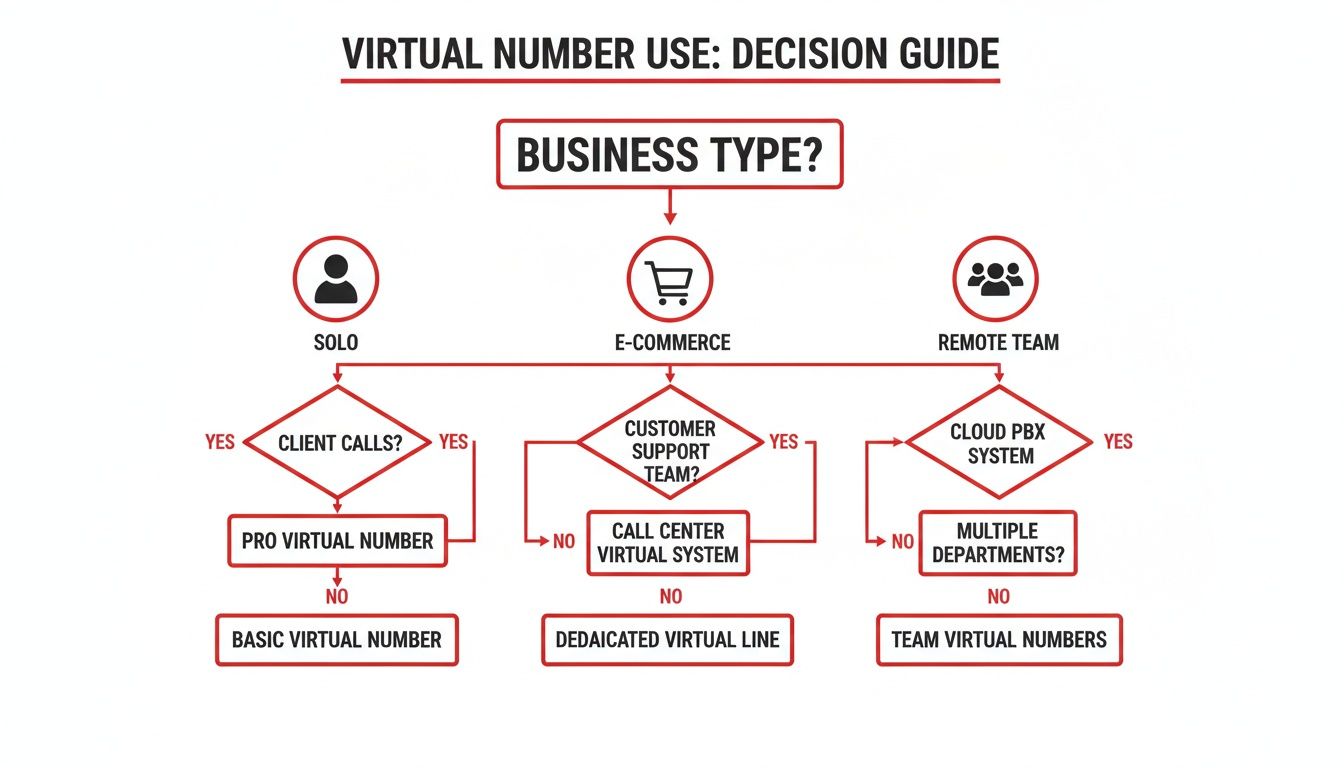
As you can see, a solo entrepreneur might care most about a great mobile app, while a larger remote team is going to need solid collaboration features.
Virtual number providers usually have a few different ways they charge for their service. Getting a handle on these models is key to finding something affordable that can grow with you—without any nasty surprise bills.
By carefully looking at reliability, security, ease of use, and cost, you can find a virtual phone number provider that will be a real asset to your business. Providers like YodelPhone focus on a transparent, pay-as-you-go model that hits these key points, giving you a solution that can scale without locking you into a rigid contract.
Making the switch to a virtual phone number always brings up a few practical questions. Let's tackle the big ones so you can feel confident you're making a smart move for your business communications.
Yes, absolutely. This is probably the most common (and most important) question we hear. You don’t have to give up the number your customers already know and trust.
The process is called number porting, and it’s a standard, painless procedure handled by every reputable provider. You can transfer your current business number from your old carrier to your new virtual system.
To your customers, nothing changes. They still dial the same number they see on your website, business cards, and marketing materials. All the technical magic happens in the background, so there’s zero disruption for your clients.
The ability to port your number removes the single biggest barrier for established businesses. It ensures continuity and preserves the brand recognition you’ve worked hard to build, all while upgrading your communication technology.
Nope! This is one of the best parts. A virtual phone number for business frees you from the clutter of clunky desk phones and the headache of complex installations. The entire system is software-based.
You and your team can make and receive calls on the devices you already use every day:
This software-first approach doesn’t just save you a ton of money on equipment; it gives your team the freedom to work from literally anywhere with an internet connection.
Top-tier providers take security very seriously. After all, your business calls often contain sensitive client details and internal information. Modern virtual phone systems are built with robust security measures to keep that data locked down.
Look for providers that use industry-standard encryption protocols like Transport Layer Security (TLS) and Secure Real-time Transport Protocol (SRTP). These technologies essentially scramble your call data while it’s in transit, making it completely unreadable to anyone who might try to intercept it. This keeps your confidential conversations private and secure, just as they should be.
Ready to unlock the flexibility and professionalism of a virtual phone system? YodelPhone offers a simple, pay-as-you-go solution that gets you started in seconds. Experience crystal-clear calls, powerful features, and the freedom to communicate from anywhere. Start your free trial today at https://yodelphone.com.

Try a free international call trial instantly in your browser - no downloads or card required. Test call quality and connect globally in seconds.

Uncover what is VoIP and how does it work with this clear, step-by-step guide. Learn the basics, benefits, and how to start making calls over the internet.

Discover how international VoIP calls can save you money and simplify global communication. Learn how they work and how to get started in minutes.

Discover how to reduce phone bills with simple audits, smarter plan choices, and money-saving tools.